Below Replacement: The Global Fertility Decline
Below Replacement: The world is quietly running out of babies. From America’s record-low 1.6 to South Korea’s 0.7, birth rates have fallen below the line of replacement almost everywhere, and the coming century will be the first in modern history where humanity stops growing and starts to shrink, nation by nation.
Sometime in the last few years, almost without anyone deciding it, humanity began to make a different choice about the future. One by one, in rich countries and poor ones, in democracies and dictatorships, people started having fewer children, and then fewer still. In the United States in 2024, the average woman was on track to have about 1.6 children in her life, the lowest figure ever recorded in the country's history. And here is the strange part, the thing that turns a statistic into a story. America is not leading this trend. It is trailing it. Across much of the world the same quiet change has already gone far further, and taken together it is reshaping the human future in ways we have barely begun to notice.
The word demographers use for all this is cold, but the idea underneath it is not. It is simply that, for the first time since the modern era began, the number of people on earth is heading toward a peak, and then a long decline. This article is a tour of that turn. How far it has gone, where it is sharpest, why it is happening at all, and what a world with far fewer children in it is likely to feel like for the people living in it.
1.6 children per US woman in 2024, a record low
0.72 South Korea's rate, the lowest ever recorded
2.1 the level a society needs just to replace itself
What "below replacement" means
Everything in this story turns on a single number, so it is worth a moment to make friends with it. That number is 2.1, and demographers call it the replacement level. It is the average number of children each woman needs to have for a population to hold steady over the long run, neither growing nor shrinking, once you set immigration aside. The logic is intuitive. It takes two children to stand in for two parents, plus a small fraction more, because slightly more boys are born than girls and because not every child lives to grow up and have children of their own. Reach 2.1 and a society quietly replaces itself, generation after generation. Fall below it, and the math bends the other way. Sooner or later, that society begins to shrink.
By that simple yardstick, most of the wealthy world stopped replacing itself a long time ago. The American fertility rate has now sat below the replacement level every single year since 2008, and in 2024 it reached a record low of 1.6. Some of that decline is genuinely good news, and it is worth saying so plainly, because the gloom can obscure it. A large share of the long fall in American births came from the collapse of teenage pregnancy, which has dropped to the lowest level ever measured. Fewer teenagers becoming parents is a social triumph, not a tragedy. But that benign thread only explains part of the picture, because the decline has long since spread past teenagers, into women in their twenties and thirties, into exactly the years when societies expect their children to arrive.
A quiet global turn
Pull back from any one country, and the pattern stops looking national and starts looking like something happening to the species. In 1950 the average woman on earth had about five children. Today she has roughly 2.3, barely above the global replacement line, and the number is still falling. More than half of all the countries and territories in the world now have fertility too low to sustain themselves, and nearly one in five has sunk into what demographers call ultra low fertility, beneath 1.4 children per woman.
This has been creeping across the map for fifty years, one region at a time. North America slipped below replacement in the early 1970s, Europe close behind it, Latin America around 2014, and Asia, the most populous region on earth, in 2019. Only Africa still sits comfortably above the line, and even Africa is expected to cross below it before this century is out. The chart below shows the long descent and where it is projected to go.
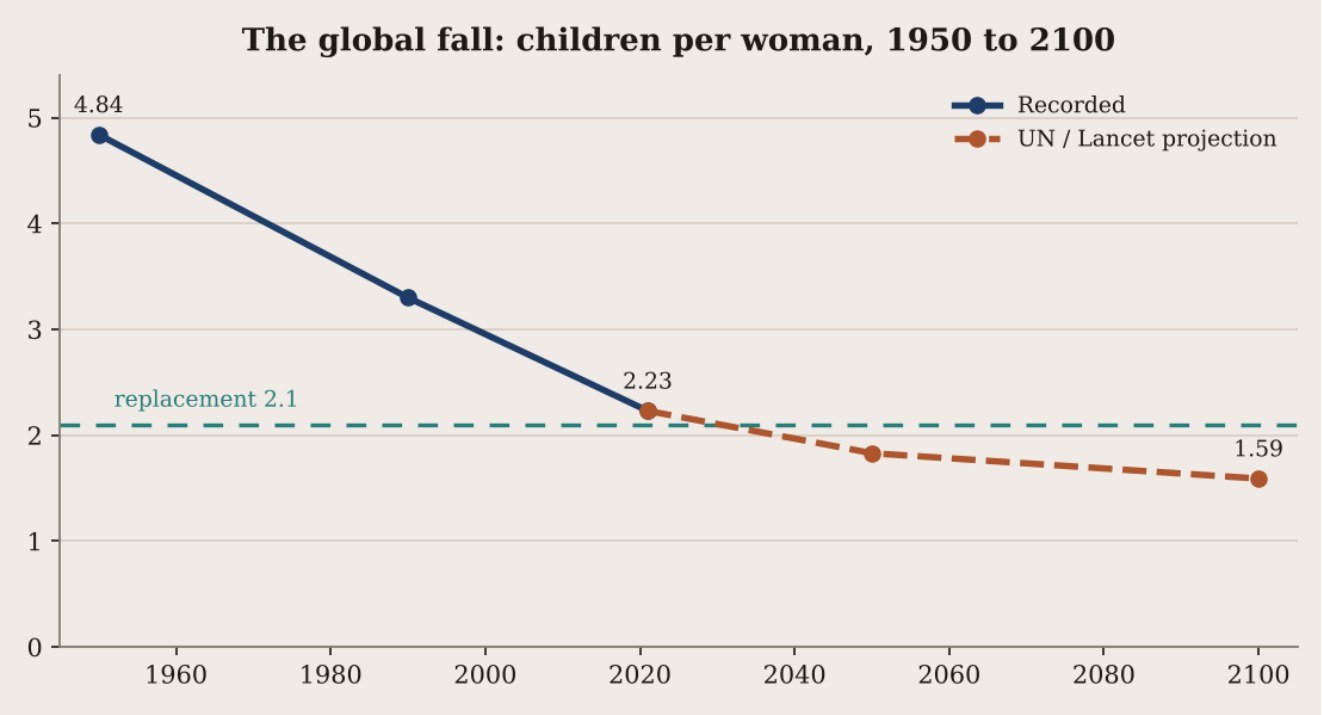
Children per woman worldwide, from nearly five in 1950 toward an estimated 1.6 by 2100. Sources: UN World Population Prospects 2024; The Lancet, 2024.
What all of this adds up to is a turning point with no precedent in the modern age. For two hundred years the human population only ever grew, and the great fear of the twentieth century was that it would grow forever and swamp the planet. That fear is now out of date. The United Nations expects the world's population, about 8.2 billion today, to rise to a peak near 10.3 billion in the middle of the 2080s, and then to begin, for the first time in modern history, to fall. Look further out and the picture grows starker still. One major study in The Lancet projected that by the end of the century all but a handful of the world's roughly two hundred countries, perhaps six of them, will no longer be having enough children to sustain themselves. The long age of human growth, the backdrop to all of recorded history, is drawing toward its close, and almost no one has reckoned with what comes next.
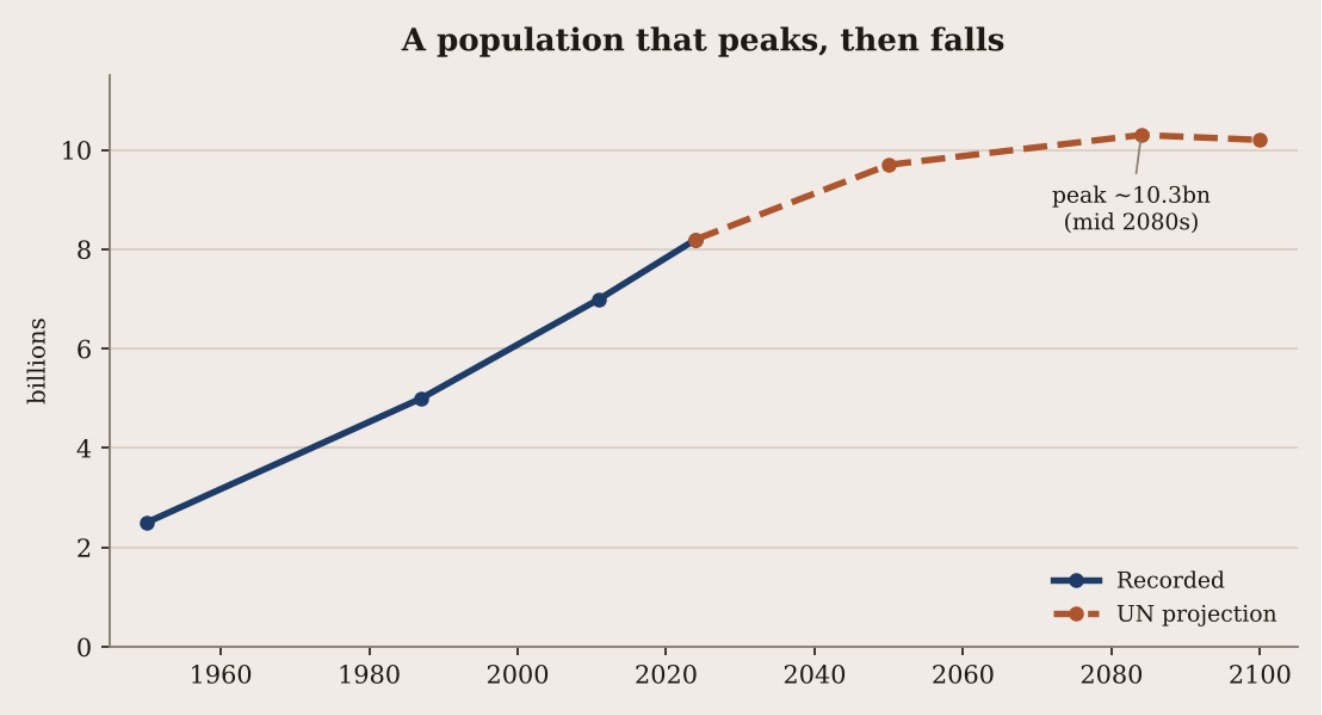
World population is projected to peak near 10.3 billion in the mid 2080s, then decline for the first time in the modern era. Source: UN World Population Prospects 2024.
The frontier: East Asia
If you want to see where the rest of the world may be heading, look at East Asia, where the decline has gone furthest and fastest, and where the numbers have passed from worrying into something close to astonishing. Nowhere is the story sharper than in South Korea, which has set and then broken the record for the lowest fertility rate on earth. In 2023 the South Korean total fertility rate fell to 6 0.72, a figure so low it is hard to hold in the mind. A rate of 0.72 means that if it held, each generation would be less than a third the size of the one before, that a hundred grandparents would have roughly thirteen grandchildren between them. In Seoul, the capital, the rate was lower still, around 0.58. 8
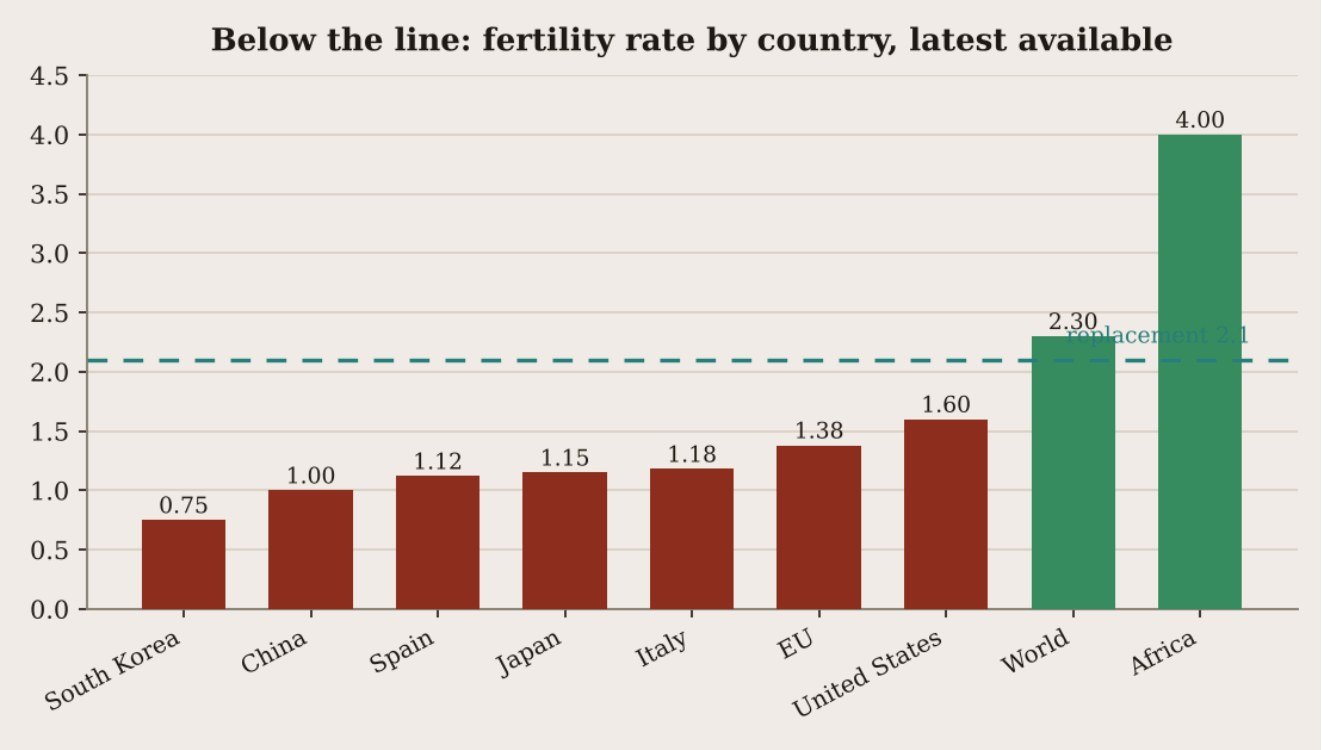
Latest available total fertility rate by country. Red marks the countries sitting below the replacement level of 2.1. Sources: national statistics agencies; Eurostat; UN; Pew Research.
There is a flicker of better news in the Korean figures, and it deserves honest mention, because the story is not purely one of freefall. In 2024 the national rate ticked up to 0.75, the first annual increase in nine years, and early figures for 2025 suggest a further rise toward 0.80, with the number of births growing at the fastest pace in nearly two decades. 7 9 Whether this is a genuine turn or a brief bounce, helped along by weddings delayed through the pandemic finally taking place, no one yet knows. What is certain is that even this improvement leaves South Korea far below any level that would sustain its population, and that the country has not bought the rise cheaply. The government has poured enormous sums into the problem over the years, by one widely cited estimate on the order of two hundred billion dollars across sixteen years, with results that, until very recently, were only the steady march downward. 10
Japan tells a quieter but no less sobering version of the same story. Its fertility rate fell to 1.15 in 2024, the lowest since records began in 1947, and for the first time in the nation's history the number of babies born in a year slipped below seven 11 hundred thousand. Set that against the deaths, more than 1.6 million in the same year, and the arithmetic of decline becomes brutally plain. Japan lost roughly 919,000 people in a single year through natural change alone, births minus deaths, the equivalent of a good sized city vanishing from the map every twelve months. 11 This is not a projection or a fear. It is the present tense, a country growing visibly older and emptier year by year.
686,000
Japanese births in 2024, below 700,000 for the first time in the nation's recorded history
Then there is China, where the sheer scale turns a national trend into a global event. For decades China worried about having too many people and enforced a strict one child policy to hold the numbers down. That era is over, and its aftermath has been swift. China eased the one child rule in the middle of the last decade, moved to a two child limit, then a three child limit in 2021, and none of it 14 has worked. The population has now fallen for several consecutive years, dropping by well over a million people in 2024 alone, and annual births have collapsed from a recent peak of more than eighteen million in 2016 to under ten million, with the newest figures showing a further steep fall toward eight million. 12 13 14 Demographers estimate the Chinese fertility rate at around 1.0, less than 14 half the level needed to hold the population steady. The country that spent a generation fearing its own numbers is now watching them shrink faster than almost anyone predicted, and because China is so vast, its decline alone is enough to bend the trajectory of the entire human population.
Europe grows old
Europe sits in the middle of the global story, less extreme than East Asia but further down the road than most, and its numbers have their own quiet drama. The European Union as a whole recorded its lowest fertility rate on record in 2023, about 1.38 children per woman, down sharply from the year before, and the number of babies born across the bloc fell by more than five percent in a single year, the steepest annual drop since 1961. 15 Behind that average lies a familiar geography, with the lowest rates clustered in the south and the Mediterranean, Malta near 1.06 and Spain near 1.12, and the relatively higher ones, still well 15 below replacement, in France and the Nordic countries.
Italy has become the emblem of the European decline, and its figures read like an elegy. In 2024 just under 370,000 babies were born in Italy, the fewest in any year since the country was unified in 1861, and the sixteenth consecutive year of decline. 16 17 The Italian fertility rate slipped to 1.18, an all time low, and the average Italian mother now has her first child at nearly 32, a full four years later than her counterpart in the mid 1990s. 16 That last number points at something important, because the delay is itself part of the mechanism. A country whose women begin having children in their thirties rather than their twenties will record fewer births each year even if the eventual family sizes were to hold, and in Italy they are not holding either. The result is a nation visibly thinning out, its villages emptying, its schools closing, its median age climbing toward the highest in the world.
369,944
births in Italy in 2024, the fewest in any year since the country was unified in 1861
Why it is happening
The natural question is why, and the honest answer is that there is no single cause, but a tangle of them that happen to pull in the same direction. The first and most obvious is economic. Raising a child has become staggeringly expensive in the modern world, and the two costs that weigh heaviest, housing and childcare, have risen fastest of all. Young adults who cannot afford a stable home, or who would lose a second income to childcare bills that rival a mortgage, delay children or forgo them, and the delay alone, as Italy shows, drives the numbers down. When American adults who do not expect to have children are asked why, affordability is among the reasons most often named. 18
But economics is only part of it, and the part that money cannot explain may be the larger one. The deepest driver is the transformation of women's lives, and most of that transformation is an unambiguous good. As women gained education, careers, and control over their own fertility through reliable contraception, childbearing became a choice rather than a default, and marriage and motherhood moved later and later in life. A world in which women can decide whether and when to have children is a better world, and it is also, as it turns out, a world with fewer children in it. Layered on top of this is a quieter shift in values, visible in survey after survey. When that same group of American adults is asked why they do not expect to have children, the single most common answer is not cost or careers or the state of the world, striking though those are. It is simply that they 18 do not want to. A great many people, given the genuine freedom to choose, are choosing other lives, and no society has yet discovered how to change that preference, or whether it has any business trying.
Demographers draw a useful distinction here between two things that look alike. One is timing, which they call tempo, the postponement of births to later ages, which pushes the annual birth rate down even if women eventually have just as many children. The other is quantity, which they call quantum, an actual fall in the total number of children a woman has across her whole life. For years optimists hoped that most of the decline was merely tempo, a delay that would correct itself as postponed births arrived later. The grim lesson of the past decade is that the delay has increasingly become denial, that births postponed are often births that never happen, and that the quantum, the real completed number, is falling too.
What a shrinking world means
It is tempting to greet all this with a shrug, or even relief. A planet of fewer people might mean less strain on the climate, less crowding, more room to breathe. There is something to that in the very long run. But the transition itself, the long passage from a growing population to a shrinking one, carries a specific and serious cost, and it is worth being clear about what it is. The problem is not the eventual smaller number. The problem is the shape of the population on the way there, because a society that stops having children does not simply get smaller. First, and for a long time, it gets old.
The mechanism is a matter of arithmetic. When each generation is smaller than the one before, the old come to outnumber the young, and the ratio of retirees to working age people climbs steadily. Across the wealthy democracies, the number of people over 65 for every hundred of working age has risen from around 19 in 1980 to about 31 today, and is projected to reach roughly 52 by 2060, which is to say that a system that once had five workers for every retiree is heading toward 19 two. This is the number that keeps finance ministers awake, because almost every modern state funds its pensions and its health care for the old out of the taxes of the young and working. Fewer workers supporting more retirees means one of three uncomfortable things, higher taxes, lower benefits, or more debt, and usually some grinding combination of all three. The fiscal strain now buckling governments across the rich world, the pension fights and the health care squeezes, is in large part the opening phase of exactly this demographic shift. The same arithmetic weighs on growth itself. With the working age population shrinking as the baby boomers retire, the engine of economic expansion loses cylinders, and forecasters expect the growth of output per person across the advanced economies to slow markedly in the coming decades unless productivity 19 rises enough to compensate.
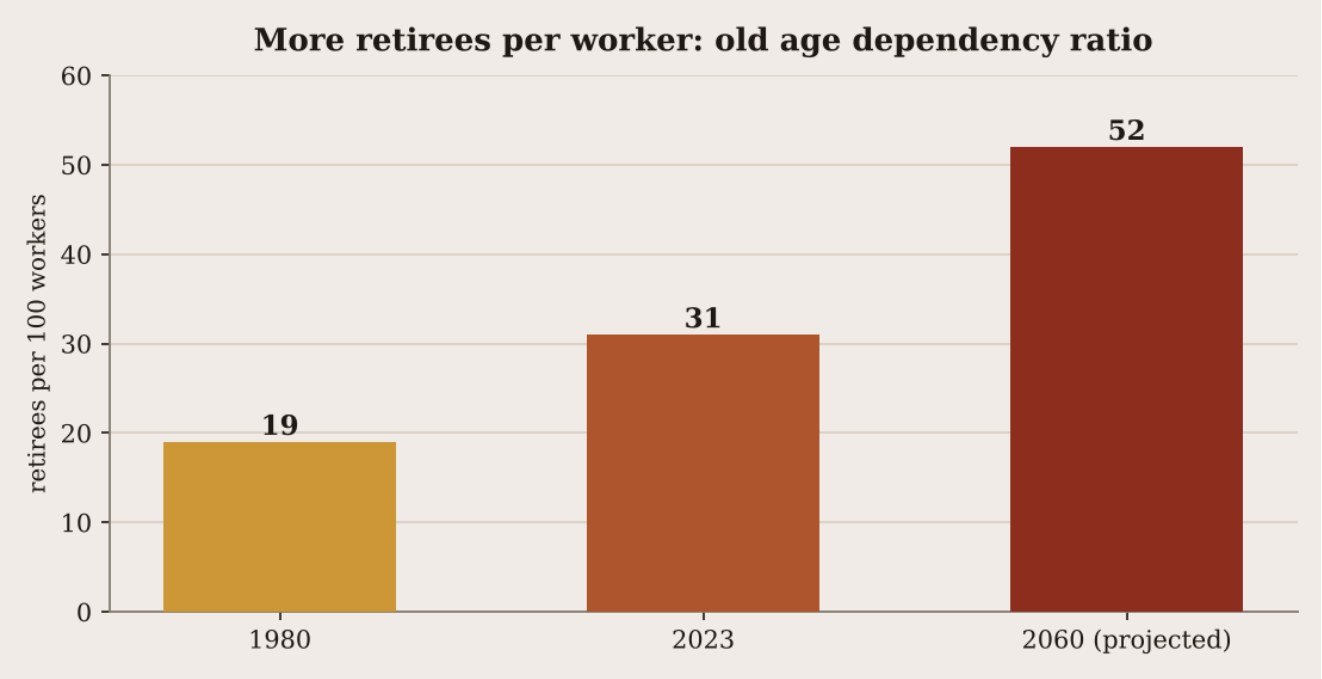
Across the wealthy democracies, the number of retirees for every 100 working age people. Source: OECD, 2025.
Can anything reverse it
Faced with these numbers, governments have tried to raise birth rates, and the results are a lesson in humility. The most committed experiment is Hungary, which has poured something like five percent of its entire economy into encouraging families, with cash grants, subsidized loans that are forgiven as couples have more children, and a lifetime exemption from income tax for mothers of four. For a while it seemed to work, as the Hungarian rate climbed from about 1.23 in 2011 to 1.61 by 2020. Then it fell back, to around 1.39 by 2024, and the government's goal of 20 reaching replacement by 2030 now looks out of reach. The sobering interpretation is that much of the early gain was tempo rather than quantum, births pulled forward in time rather than additional children, a reshuffling of the calendar that flatters the annual statistic without changing the final total. South Korea's experience points the same way. It has spent on the order of two hundred billion dollars across two decades, and still has the lowest fertility rate in the world. 10
The pattern across every attempt is consistent and discouraging. Cash helps families who were already going to have children, and it can shift the timing, but it has proved remarkably weak at changing the underlying decision of how many children to have. The forces pushing fertility down, the cost of housing, the rise of women's autonomy and ambition, the simple shift in what people want from their lives, are deep and cultural, and they do not yield easily to a subsidy. This is why a growing number of analysts argue that the only reliable way for a rich country to offset a shrinking population in the near term is not more births but more immigration, the importing of working age people from the places that still have a surplus of them. That is a real option, and the countries most open to it will age more gently. But it is a politically explosive one, as the migration battles across Europe and the United States make plain, and it relocates the problem rather than solving it, since the sending countries are aging too.
The century of fewer
So the world stands at a hinge in its history, and it has arrived there almost without noticing. For all of recorded time the human story has been one of more, more people, more growth, each generation larger than the last, and the entire architecture of our economies, our pensions, our politics, and our expectations was built on that assumption. That assumption is now failing, quietly, in the most intimate decision a person can make, and it is failing not through catastrophe but through choice, the accumulated free decisions of hundreds of millions of people who have looked at the lives available to them and concluded that fewer children, or none, is the life they prefer. There is no villain in this story and no easy fix, which is precisely what makes it so hard for governments to face.
What comes next is genuinely uncertain. Perhaps fertility will stabilize at a new and lower normal, and societies will learn to be smaller and older without losing their footing. Perhaps the slight upticks now visible in Korea and a few other places are the first sign of a floor. Or perhaps the decline will deepen, and the century ahead will be defined by the strange new problem of too few people rather than too many, of nations competing not for territory but for the young. What is no longer in doubt is the direction. The great growth is ending, the cradle is emptying, and the coming century will belong, for the first time in the modern age, to a human population that is no longer growing but beginning, slowly and then not so slowly, to shrink. How we meet that is one of the central questions of the age, and we have barely begun to ask it.
A world of shrinking nations
The abstraction of a falling birth rate becomes concrete when you translate it into the fate of particular countries, and the projections are sobering. The United Nations expects that, on current trends, many of the world's nations will not merely grow more slowly but actively shrink, several of them dramatically, over the rest of this century. China, the most populous nation of the modern era, is projected to fall from about 1.4 billion people today to roughly 630 million by 2100, a loss of more than half. 22 23 South Korea is projected to drop from around 52 million to about 22 million, Italy from 59 million to 35 million, Japan from 123 22 million to 77 million. These are not fringe cases. They are among the largest and most advanced economies on earth, and the same curve, to varying degrees, bends downward across Europe and East Asia alike, even as parts of Africa are projected to double.
10.3bn the human peak, projected for the mid 2080s
63 countries already past their population peak
-55% China's projected change in population by 2100
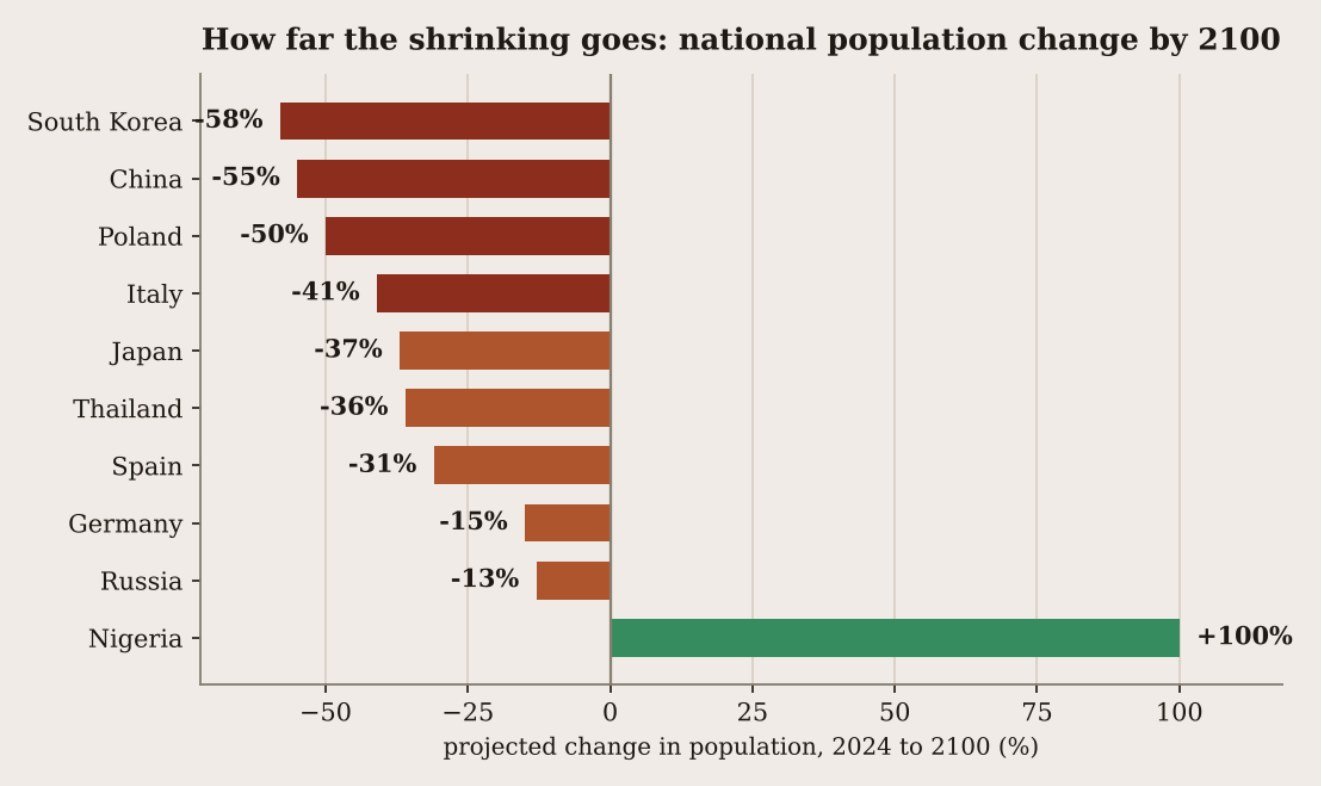
Projected change in national population from 2024 to 2100, UN World Population Prospects 2024 (medium variant). Many developed and East Asian nations are projected to shrink by a third or more, while parts of Africa, such as Nigeria, continue to grow.
This is not a problem waiting in the future. It has already begun. As of 2024, some 63 countries and territories, among them China, Germany, Japan, and Russia, had already passed their peak population and entered long term decline, with roughly 2 48 more expected to peak within the next three decades. The map of human population, which for two centuries only filled in, has started, in a growing number of places, to empty out.
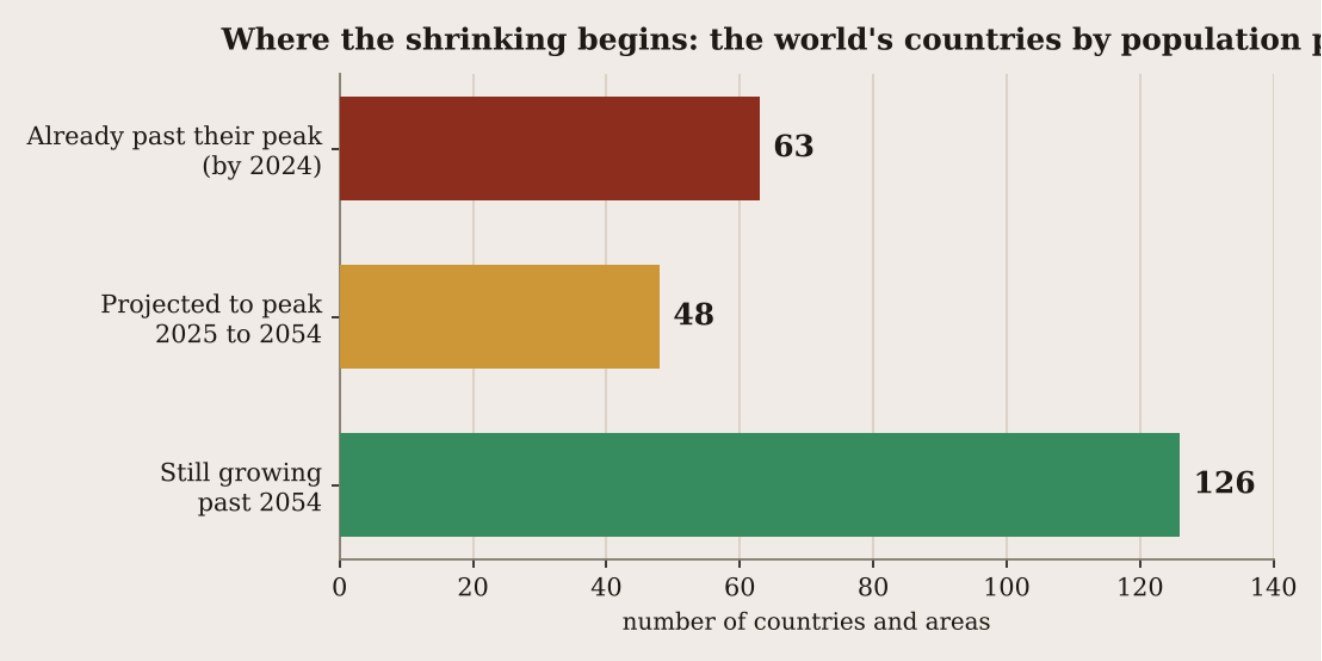
By 2024, 63 countries and areas had already passed their population peak, and another 48 are projected to peak by 2054. Source: UN World Population Prospects 2024.
The question for this century, then, is not whether many nations will shrink. The data says they will. The question is whether they can grow older and smaller without growing poorer and more divided in the process, and that is a test no society has yet passed.
Sources
1. Births: Final Data for 2024. National Vital Statistics Reports, Vol. 75, No. 2. CDC / National Center for Health Statistics, June 2026. https://www.cdc.gov/nchs/data/nvsr/nvsr75/nvsr75-02.pdf 2. World Population Prospects 2024: press release, UN projects world population to peak within this century. United Nations, 11 July 2024. https://www.un.org/sustainabledevelopment/blog/2024/07/pres s-release-wpp2024/ 3. World Population Prospects 2024: Key Messages. UN Department of Economic and Social Affairs, Population Division, 2024. https://population.un.org/WPP/Publications/Files/WPP2024_Key-Messages. pdf 4. 5 facts about global fertility trends. Pew Research Center, 15 August 2025. https://www.pewresear ch.org/short-reads/2025/08/15/5-facts-about-global-fertility-trends/ 5. Global fertility in 204 countries and territories, 1950 to 2021, with forecasts to 2100 (GBD 2021 Fertility and Forecasting Collaborators). The Lancet, March 2024. https://www.thelancet.com/journal s/lancet/article/PIIS0140-6736(24)00550-6/fulltext 6. S Korea breaks record for world's lowest fertility rate, again. Al Jazeera, 22 February 2023. https:// www.aljazeera.com/news/2023/2/22/s-korea-breaks-record-for-worlds-lowest-fertility-rate-again 7. South Korea birthrate rises for the first time in nine years. Al Jazeera, 26 February 2025. https://w ww.aljazeera.com/news/2025/2/26/south-korea-birthrate-rises-for-the-first-time-in-nine-years 8. Newborn numbers rise in 2024 for first time in 9 years (Statistics Korea). The Korea Times, 27 August 2025. https://www.koreatimes.co.kr/economy/20250827/newborn-numbers-rise-in-2024-for-1s t-time-in-9-years 9. South Korea's birthrate, the world's lowest, rises again amid signs of easing demographic crisis. Reuters, via The Star, 25 February 2026. https://www.thestar.com.my/aseanplus/aseanplus-news/202 6/02/25/south-korea039s-birthrate-the-world039s-lowest-rises-again-amid-signs-of-easing-demographi c-crisis 10. South Korea's birth rate remains alarmingly low despite spending 200B dollars in 16 years. Anadolu Agency, 2023. https://www.aa.com.tr/en/asia-pacific/south-koreas-birth-rate-remains-alarmin gly-low-despite-spending-200b-in-16-years/2879778 11. Japan's fertility rate falls to record low in 2024 (Ministry of Health, Labour and Welfare). The Japan Times, 4 June 2025. https://www.japantimes.co.jp/news/2025/06/04/japan/fertility-rate-low 12. China's population declines for third consecutive year (National Bureau of Statistics). Reuters, via The Tribune, 18 January 2025. https://www.tribuneindia.com/news/world/chinas-population-declines-f or-third-consecutive-year 13. End of China's one child policy sees births rise to 18.46 million. South China Morning Post, January 2017. https://www.scmp.com/news/china/policies-politics/article/2064580/end-chinas-one-chil d-policy-sees-births-rise-1846 14. China's population falls again as birth rate drops to lowest since 1949. AP, via PBS NewsHour, 19 January 2026. https://www.pbs.org/newshour/world/chinas-population-falls-again-as-birth-rate-drops-t o-lowest-since-1949 15. Record drop in children being born in the EU in 2023. Eurostat, 7 March 2025. https://ec.europa. eu/eurostat/web/products-eurostat-news/w/ddn-20250307-1 16. Births and fertility of the resident population, Year 2024. ISTAT (Italian National Institute of Statistics), 30 October 2025. https://www.istat.it/en/?p=108782 17. Births in Italy fall to new low (ISTAT). ANSA, 21 October 2025. https://www.ansa.it/english/news/2 025/10/21/births-in-italy-fall-to-new-low_d1047bc2-4db8-49f4-87fc-1323b662135e.html 18. The experiences of U.S. adults who don't have children: reasons adults give for not having children. Pew Research Center, 25 July 2024. https://www.pewresearch.org/social-trends/2024/07/25/ reasons-adults-give-for-not-having-children/ 19. OECD Employment Outlook 2025 (population aging, dependency ratios, and growth). OECD, 2025. https://www.oecd.org/en/publications/oecd-employment-outlook-2025_194a947b-en.html 20. Hungary's fertility outcomes highlight pro natal policy limitations. American Enterprise Institute, 2025. https://cosm.aei.org/hungarys-fertility-outcomes-highlight-pro-natal-policy-limitations/ 21. Which countries have fertility rates above or below the replacement level (UN World Population Prospects 2024). Our World in Data, 2025. https://ourworldindata.org/data-insights/which-countries-h ave-fertility-rates-above-or-below-the-replacement-level 22. Population projections by country to 2100 (UN World Population Prospects 2024, medium variant). INED, French Institute for Demographic Studies. https://www.ined.fr/en/all-about-populatio n/data-graphs/projections-countries
23. 5 facts about how the world's population is expected to change by 2100. Pew Research Center, 9 July 2025. https://www.pewresearch.org/short-reads/2025/07/09/5-facts-about-how-the-worlds-popula tion-is-expected-to-change-by-2100/


Discussion
React, reply, and talk it through with other readers.