Automatically translated · the author has not supplied this language
构建还是购买
Building with AI is almost free. The catch is that “almost free” is measured in the one currency you can never earn more of: your time.
The True Cost of the Solo AI Founder versus Hiring at $150 an Hour
XXL BOLÍGRAFO
A ONE HOUR READ · OCTOBER 2026
Introduction: the question every builder now faces
Ask any person building a product today and you will eventually arrive at the same fork in the road. Do you build it yourself, with the astonishing new leverage that AI provides, and pay for it mostly in your own hours? Or do you pay a tech company or a contract engineer, at something like $150 an hour, and buy your way past the labor entirely? On its surface this looks like a simple money question. It is not. It is a question about which of your two scarcest resources, cash or time, you are willing to spend, and the honest answer changes dramatically depending on numbers that most builders never actually calculate.
This report is an attempt to calculate them. It takes the two paths, the solo builder working with AI for a year and the engineer billed at $150 an hour, and it prices out every real line item on both sides, not just the obvious ones. On the solo side that means the toolset subscriptions, the AI tokens that behave like a utility bill, the platform and hosting costs, the app store fees, the learning curve, and above all the value of your own time. On the hiring side it means the hourly billing, but also the hours you still spend managing and specifying the work, which never go away.
The goal is not to declare one path universally better, because neither is. The goal is to find the specific conditions under which each one wins, to locate the crossover point where the decision flips, and to give you a framework precise enough that you can drop in your own two numbers, what your time is worth and how long the build will take, and know which side of the line you are standing on. By the end, the fork in the road will look less like a matter of taste and more like a calculation, which is what it actually is.
We will start with the part everyone gets right, which is the cash, and then move steadily into the parts everyone gets wrong.
Part One: The cash illusion
Begin with the simplest comparison, the one that makes the solo path look like an obvious landslide, because it is important to see both why it is true and why it is misleading.
On pure cash outlay, there is no contest. A dedicated engineer at $150 an hour, working something close to full time across a year, runs to roughly $300,000 for about 2,000 hours. Even a far more modest engagement, the 500 to 1,000 hours it might take to build and iterate a real product, lands between $75,000 and $150,000 in cash. Against that, the solo builder working with AI spends almost nothing in cash terms, a few thousand dollars a year for tools and hosting. The two lines do not just diverge. They fly apart.
The chart below makes the gap concrete. The hired line climbs steeply and without pause, because every hour has a price tag stapled to it. The solo line is nearly flat along the bottom, barely lifting off the floor even as the hours pile up. The cash break even arrives almost instantly. Past roughly 20 hours of engineering, the solo path is cheaper in cash, and from there the distance only grows.
If cash were the only resource that mattered, we could stop here and the answer would be build it yourself, every time, without exception. But cash is not the only resource, and treating it as if it were is the single most expensive mistake a builder can make. The flat solo line in this chart is a lie of omission. It shows only the money, and the money was never the real cost of building something yourself. The real cost is sitting invisibly underneath that flat line, and the rest of this report is about dragging it into view.
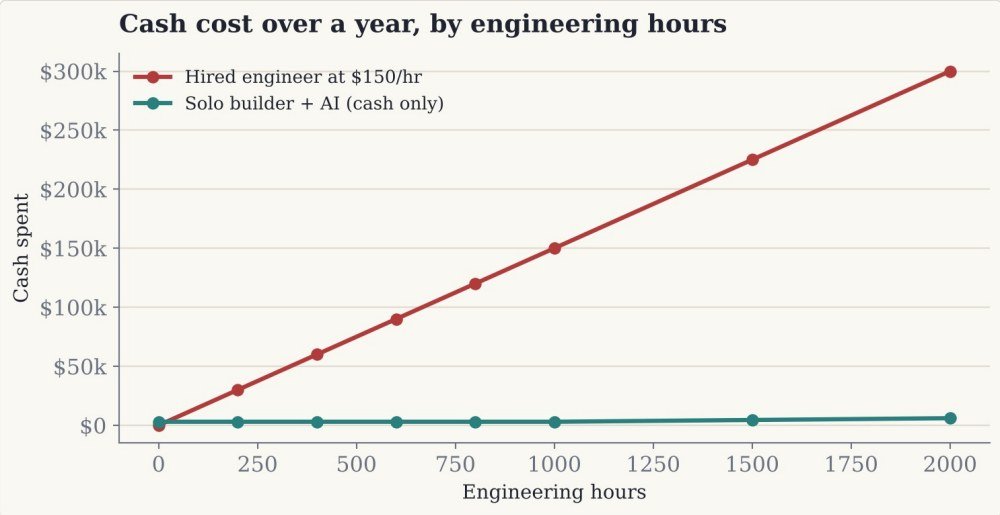
The cash gap is enormous and immediate, but cash is only one of the two resources in play. The solo line hides its true cost, which is time.
Part Two: Anatomy of the solo cost stack
Before we price the time, we should be honest about the cash, because even the small solo cash figure is made of more parts than most builders track. When people say the solo route costs almost nothing, they are usually thinking only of a single AI subscription. The real stack has at least four distinct cash components, and under heavy use it is not trivial.
The first is the toolset, the flat subscriptions. An AI coding assistant, a frontier model plan or two, perhaps a design tool. This runs from around $600 a year on the light end to $3,600 or more if you are paying for premium tiers of several tools at once.
The second is tokens, the metered AI usage that goes beyond your flat plans, and this is the sneaky one that we will return to in its own section. The third is the platform, meaning the hosting, database, authentication, email, storage, and monitoring that any real product needs to actually run, which we will also break out separately. And the fourth is the app store and developer cost, which for anyone shipping mobile apps includes the annual developer account and store fees.
Stacked together, as the chart shows, the solo cash cost spans a wide range depending on how heavily you build. On the low end, a light user prototyping carefully, it is around $2,500 a year. In the middle, a serious builder shipping real products with moderate usage, it is around $7,500. On the high end, someone running heavy agentic coding and wiring AI into the product itself, it climbs toward $16,000 or beyond. That is still a fraction of a single month of a hired engineer, so the cash advantage holds. But $16,000 is not nothing, and pretending the solo path is free sets you up to be surprised by the bills, especially the token bill, which can behave very differently from the fixed subscriptions people expect.
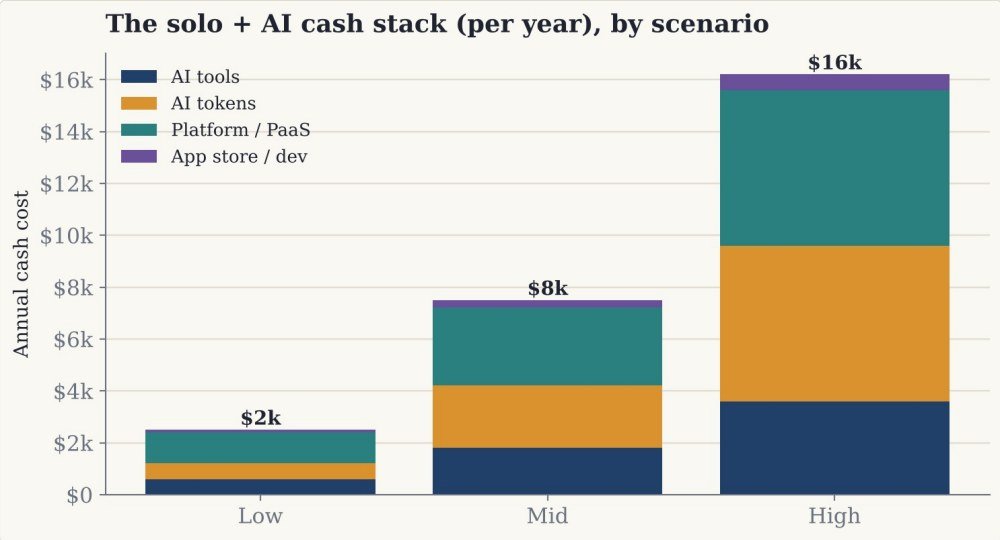
The solo cash stack has four parts and a wide range. Even the high end stays far below a hired engineer, but it is not free, and tokens are the volatile piece.
Part Three: Tokens behave like a utility, not a subscription
The component that surprises builders most is tokens, the metered cost of the AI usage itself, because it does not behave like the flat monthly subscription people mentally file it under. It behaves like electricity. The more you run the machine, the more you pay, and the heaviest ways of working with AI are precisely the ones that run the machine hardest.
If you are using AI lightly, mostly chatting with a model to think through problems and generate the occasional snippet, your usage may sit comfortably inside a flat plan and cost very little beyond it, perhaps a few hundred dollars a year. But the moment you move to daily heavy coding, and especially to agentic workflows where the AI is autonomously reading your codebase, running tools, and generating large volumes of code across many steps, the metered usage climbs steeply. Wire AI into the product itself, so that every user interaction triggers model calls you pay for, and you have added a genuine variable cost that scales with your own success.
The chart lays out this progression. Light usage is cheap. Moderate daily coding is manageable. Heavy agentic building is a real line item. And intensive use, where AI is both your builder and a feature of the product, can run to $9,000 a year or more, rivaling the entire rest of the solo cash stack combined.
The practical lesson is to treat tokens the way a factory treats its power bill. Monitor it. Set a cap. Know your burn rate per week, not just per month, because agentic tools can quietly accelerate. Many builders get a nasty surprise not because any single action was expensive, but because the frictionless ease of asking the AI to do one more thing meant they asked it ten thousand times. The same ease that makes solo building so powerful is the ease that runs up the meter, which is a pattern you will see repeat throughout this analysis. Frictionless and free are not the same thing.
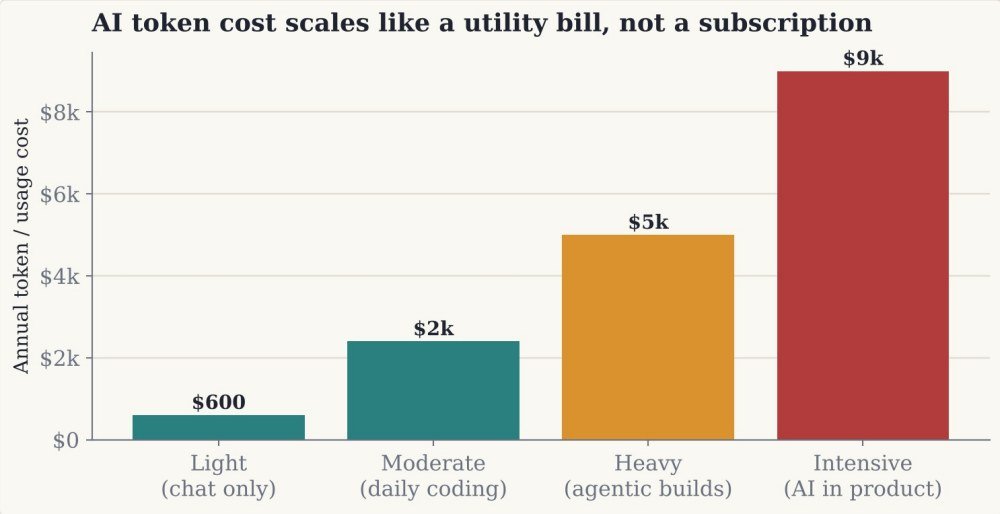
Token cost is metered. It stays small for light use and climbs sharply for agentic and in-product usage, where it can rival the whole rest of the cash stack.
Part Four: Platform and infrastructure, the cost that grows with success
The fourth cash component, the platform, has a property worth dwelling on, because it is the one cost on the solo side that grows precisely when things go right. Hosting, databases, authentication, file storage, email delivery, monitoring, and the domain itself form the plumbing that any real product needs to run, and that plumbing gets more expensive as the product attracts more users.
When you are prototyping, the platform cost is almost nothing. The free and near free tiers of modern platform providers will carry a project with a handful of test users for a few hundred dollars a year. At the MVP and launch stage, with real users arriving, you move onto paid tiers and the annual cost climbs into the low thousands. As the product scales, with meaningful traffic, larger databases, and higher reliability requirements, infrastructure moves into the mid thousands and keeps climbing. A genuinely high traffic product can run platform costs well into five figures a year, and at that point you have the good problem of a product successful enough to justify it.
The chart shows this staircase. The important insight is that platform cost is not really a cost of building. It is a cost of operating, and it exists no matter who built the thing. Whether you wrote every line yourself with AI or paid an engineer $150 an hour, the running product incurs the same hosting bill. So in a strict comparison of build or buy, platform cost is roughly a wash between the two paths, which is why it is easy to overlook, and also why it is a mistake to count it as a point in favor of hiring. It belongs to the product, not to the method.
What does belong to the method, and what we have been deferring, is the largest cost on the solo side by far, the one that never appears on any invoice. Your time. It is time to confront it directly.
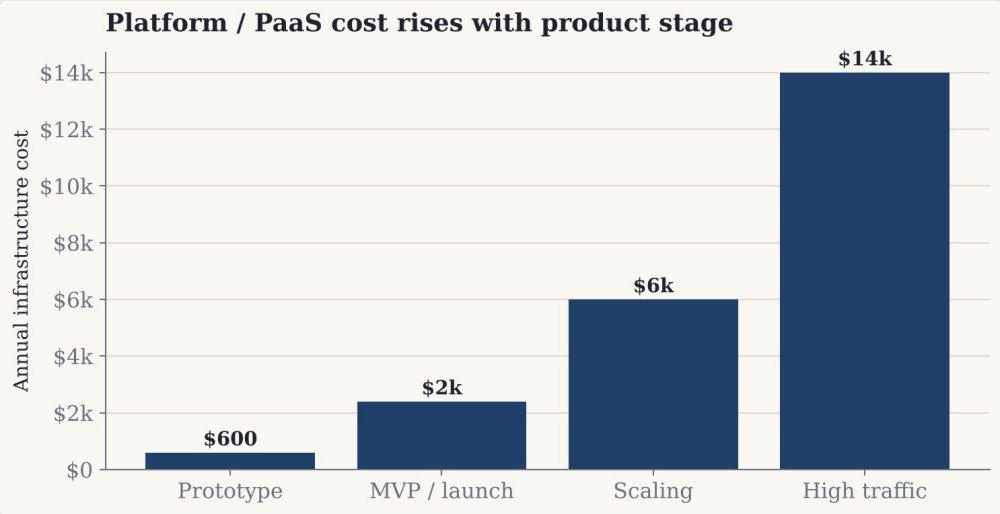
Platform cost grows with the product, not the method. It is roughly the same whether you build solo or hire, so it does not favor either path.
Part Five: The learning curve, paid once and then owned forever
Among the solo costs, the learning curve has a special character that sets it apart from all the others, and understanding that character is one of the keys to the whole decision. It is a real cost, it is often significant, and it is almost always a one time investment rather than a recurring expense.
Learning to build effectively with AI is not free. It takes real time to understand the different models and their distinct strengths and weaknesses, to develop a workflow that reliably produces good results rather than impressive looking garbage, and to build the judgment to know when the AI is quietly wrong. Depending on your starting point, this might be 60 hours or it might be 150, a meaningful chunk of time that produces nothing shippable on its own. For a honest accounting, that time has to be counted.
But here is the crucial property. You pay it once. The hours you invest in learning the craft of AI assisted building are not spent again on the next project, or the one after that. They become a permanent capability that you carry forward and reuse indefinitely. The chart shows what this means in practice. If you charge the full learning cost against a single project, it looks expensive. Spread it across two projects, and the per project cost halves. Across six projects, the learning curve has nearly vanished as a line item, diluted to almost nothing.
This is the structural advantage of the solo path that the pure cash comparison completely misses. When you learn to build, the investment compounds. Every future project draws on it for free. Contrast this with hiring, where the money you spend on an engineer evaporates with the project and leaves you with no retained capability at all. You paid, the work got done, and you are exactly as unable to do it yourself as you were before. The solo builder's learning curve is not a cost in the ordinary sense. It is the purchase of an asset, and the asset keeps paying out. We will return to this compounding effect, because for anyone who intends to build more than one thing, it may be the single most important factor in the entire analysis.
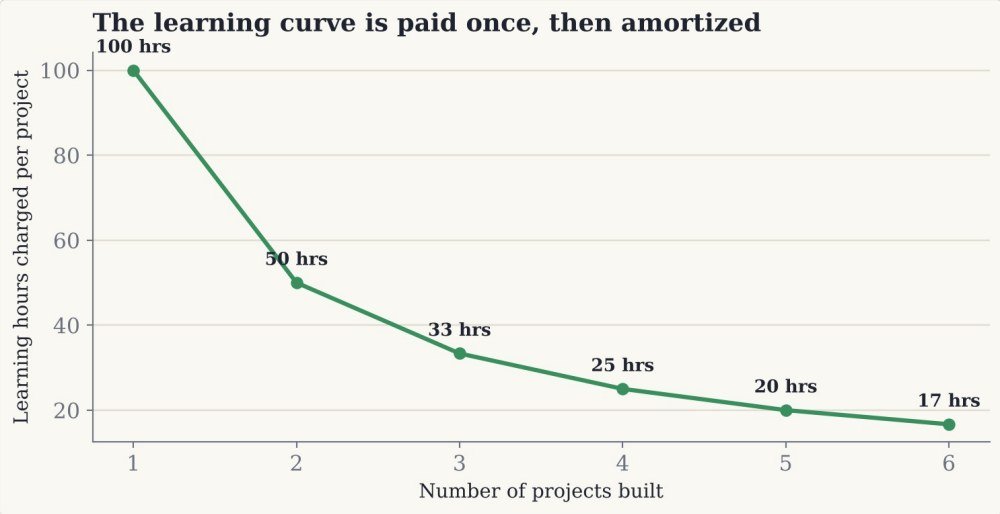
The learning curve is a one time investment. Spread across multiple projects, it falls to almost nothing per project, and it leaves you owning a reusable capability.
Part Six: The real cost is time
We have now accounted for every dollar on the solo side. Added up in the middle scenario, the full cash stack, tools and tokens and platform and store fees together, comes to roughly $7,500 for the year. Against a hired engineer that is a rounding error, and if cash were the whole story the analysis would be over. But we have been deferring the real cost all along, and it is time to put a number on it.
The real cost of the solo path is your time, and in almost every realistic scenario it dwarfs the cash by an order of magnitude. Consider a concrete example. A capable builder spends about 900 of their own hours over the year on a real product, 100 learning and refining their workflow and 800 actually building. If we value that time at even a modest $60 an hour, the time cost is $54,000. Set beside the $7,500 of cash, the picture inverts completely. The cash, which was the entire basis of the solo path's apparent advantage, turns out to be less than one eighth of the true cost. The other seven eighths is time, and time was invisible on the invoice.
The chart makes the imbalance impossible to ignore. The cash bar is a sliver. The time bar towers over it. This is the single most important realization in the entire build or buy question, and it is the one that the seductive cheapness of AI tools actively hides from you. Because the tools are cheap and the building is pleasant, it feels free. It is not free. It is being paid for in the one currency you can never earn more of, drawn down hour by hour from an account that does not refill, and the fact that no invoice ever arrives for it does not mean it was not spent.
Once you accept that time is the real cost, the entire comparison transforms. It is no longer a question of a few thousand dollars against a hundred thousand. It is a question of how much your time is worth, and how much of it this will actually consume. Those two numbers, your hourly value and the hour count, are what truly decide build or buy, and everything from here is about pinning them down.
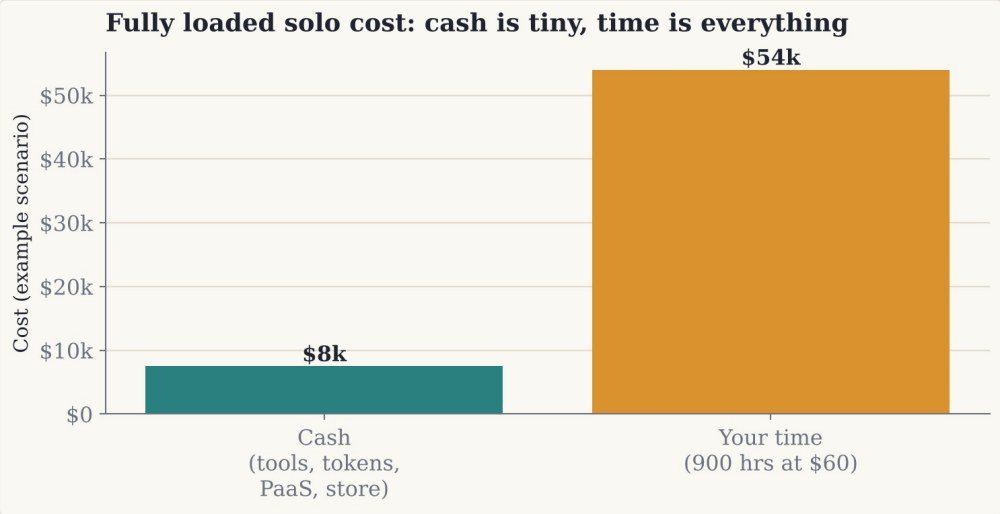
Once you price your own hours, the cash shrinks to a sliver. Time is seven eighths of the true cost of building solo, and it never appears on any bill.
Part Seven: Pricing your hours and finding the crossover
To decide rationally, you have to price your own time, which many builders resist doing because it forces an uncomfortable honesty about opportunity cost. But there is no way around it. Every hour you spend building is an hour you did not spend doing something else, and the value of that something else is the true price of the hour, whether or not money ever changes hands.
With that price in hand, the comparison becomes a clean piece of arithmetic. The fully loaded solo cost is the cash, about $7,500, plus your 900 hours times your hourly rate. The fully loaded hiring cost is the engineer's hours, say 500 at $150 which is $75,000, plus the platform and store costs of about $3,100, plus the time you still have to spend yourself specifying and managing the work, say 150 hours at your rate. Note that hiring does not free you from time entirely. You still have to direct it, review it, and decide what gets built, which is why the management hours appear on both sides.
Set the two totals equal and solve for your hourly rate, and a crossover appears. In this scenario it lands at roughly $95 an hour. Below that rate, the solo path is cheaper, fully loaded, even after counting every token and every hour of the learning curve. Above it, hiring is cheaper, because at that point your 900 hours are simply too valuable to pour into the build yourself.
The chart draws both lines against your opportunity cost. The solo line rises steeply, because it is loaded with 900 of your expensive hours. The hiring line rises gently, because it only carries 150 of them. They cross near $95. This single chart replaces all the hand waving about whether building yourself is worth it with a precise, personal answer. Find your hourly value on the horizontal axis, read up, and whichever line is lower is your cheaper path. For a builder whose time is worth $40 an hour, solo wins by a mile. For one whose time is worth $150 an hour, hiring wins clearly. The decision was never universal. It was always a function of a number specific to you.
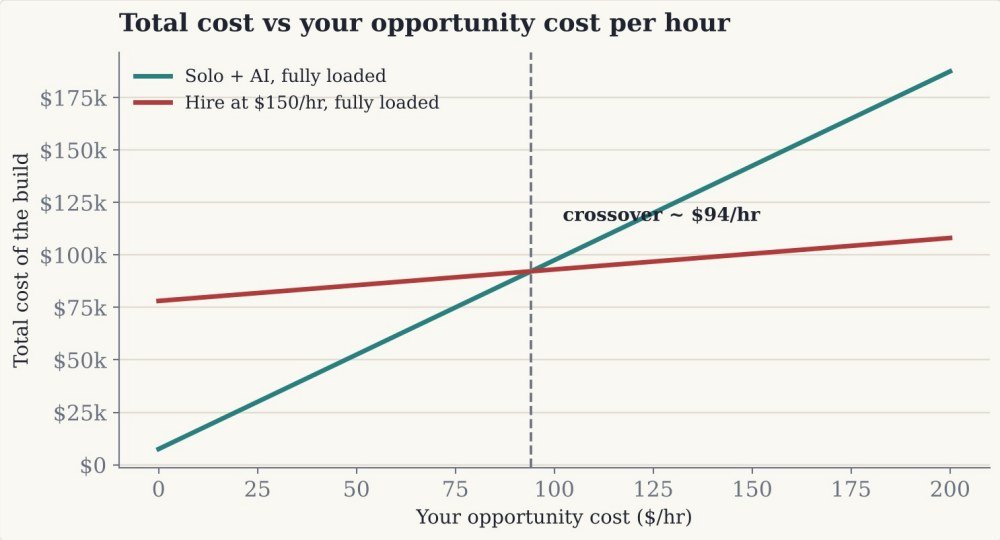
The two fully loaded cost lines cross near $95 an hour. Below your personal crossover, build solo. Above it, hire. The decision is a function of your own hourly value.
Part Eight: Sensitivity, or why the hour count changes everything
The crossover of $95 an hour was not a universal constant. It depended entirely on the assumption that the build would take about 900 of your hours. Change that assumption, and the crossover moves, sometimes dramatically. This is the most important sensitivity in the whole model, and it is worth understanding deeply, because the hour count is the variable you have the most control over and the one most likely to betray you.
The logic is straightforward. The more hours a build consumes, the more expensive the solo path becomes, because the solo path is mostly your hours. So the more hours it takes, the lower your hourly value has to be for solo to still make sense. The chart shows this relationship directly. For a lean 300 hour build, the crossover sits high, up near $280 an hour, meaning solo wins unless your time is extraordinarily valuable. For a bloated 2,000 hour build, the crossover collapses to around $38 an hour, meaning hiring wins for almost anyone whose time has meaningful value.
Read that again, because it contains the central practical warning of this entire report. The same project can favor building or hiring depending entirely on how many hours it actually takes you, and how many hours it takes you is not fixed. It is a function of your discipline. A focused builder who ships a tight product in 500 hours is operating in a world where solo is almost always right. The same builder, undisciplined, who lets that same product sprawl to 1,500 hours of endless iteration, has moved themselves into a world where they should have hired. They did not change projects. They changed their own hour count, and in doing so they crossed the line.
This is why the hour count is not a passive input you discover but an active variable you control, and why protecting it is the highest leverage thing you can do. Every hour you add through scope creep, through perfectionism, through the frictionless ease of asking the AI for one more feature, does not just cost you that hour. It lowers your crossover, pushing you steadily toward the region where you should have paid someone else. The next section is about the force that drives those hours up without your noticing.
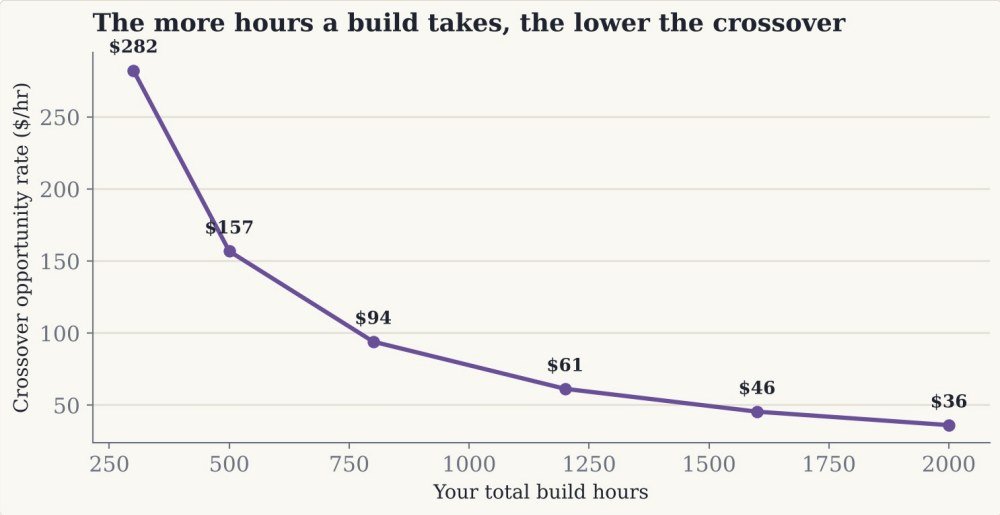
The crossover is highly sensitive to the hour count. A lean build keeps solo favorable at almost any hourly value. A bloated build pushes you toward hiring for almost anyone.
Part Nine: The infinite loop tax
There is a cost on the solo side that does not appear in any of the clean models, and it is the one most likely to quietly wreck the economics. Call it the infinite loop tax. It is the tendency, specific to AI assisted building, for the hour count to balloon far beyond the plan, because the building is so cheap and pleasant that there is always one more thing to improve and never a forced reason to stop.
In the old world of expensive, slow development, iteration had a natural brake. Every change cost real time and often real money, so you stopped when you ran out of either. In the AI world, changes are nearly free and nearly instant, which removes the brake entirely. The loop can run forever, and it will, unless you impose an ending from outside. The result is a predictable pattern. The build you planned for 600 hours takes 900 in typical practice, and if scope creep is left unmanaged, it can balloon to 1,600 or more, each added hour feeling productive, each one drawing down your irreplaceable time account, and the whole accumulation disguised as diligence.
The chart prices this out at a $60 hourly value. The planned build is a $36,000 commitment of your time. The typical build, with normal slippage, is $54,000. The scope creep build is $96,000, nearly triple the plan, and at that point you have not only blown your budget, you have crossed the hiring crossover without ever deciding to. You would have been better off paying someone, and you arrived there not through a bad decision but through the absence of a decision, through simply never stopping.
This is the hidden tax that makes the solo path riskier than its clean numbers suggest, and it is also the one most within your power to avoid. A hired engineer at $150 an hour has a brutal but useful side effect. The bleeding cash forces you to define done, to ship, and to stop. Paying by the hour is itself a form of discipline. Building for almost free removes that discipline, and the removed discipline is exactly what the infinite loop tax collects on. To build solo and come out ahead, you have to supply from your own willpower the stopping force that the invoice used to supply for you.
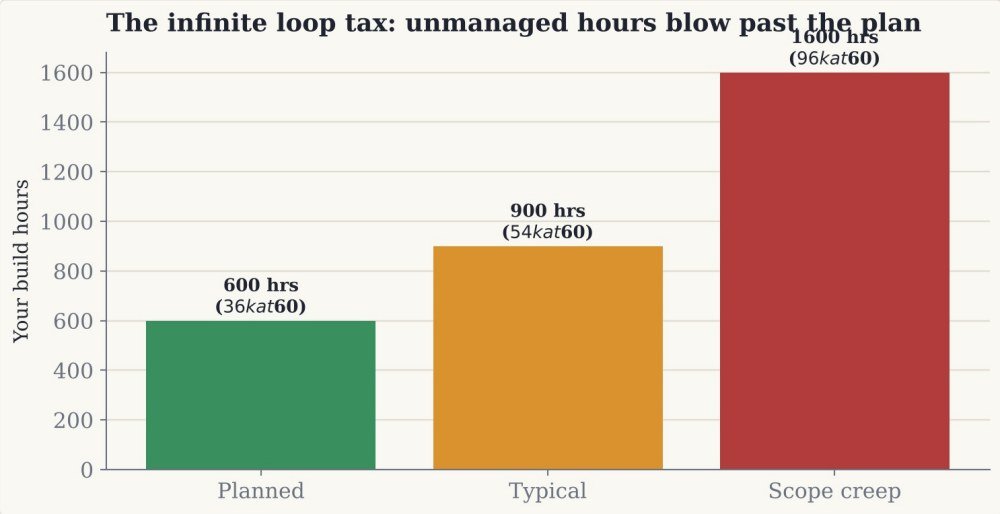
The infinite loop tax: unmanaged, AI building balloons the hour count far past the plan, and can silently push you across the hiring crossover without a decision ever being made.
Part Ten: Quality, security, and the risk you cannot see
So far the comparison has been about cost, but cost is only one axis. The other is quality, and specifically the risk that a solo AI build carries defects you are not equipped to notice. This is where hiring a senior engineer earns part of its premium, and where the honest builder has to be clear eyed about their own blind spots.
AI assisted building is genuinely good now at producing functional code quickly. What it is less reliable at is producing code that is secure, that scales gracefully, that handles edge cases, and that will not accumulate crippling technical debt. These are precisely the qualities that are invisible to a non expert, because a product can look finished and work perfectly in a demo while harboring security holes, fragile architecture, and shortcuts that will become expensive later. The danger is not that the AI writes obviously broken code. It is that it writes plausible code with subtle, serious flaws that neither you nor the AI flags, and that only an experienced engineer would catch.
The chart scores the two paths across the dimensions that matter, with higher being better. The solo AI build does respectably on reliability for ordinary use and on getting something working. It scores notably lower on security, on scalability under load, on avoiding technical debt, and on compliance, the areas where deep expertise and hard won judgment matter most. The hired senior scores higher across the board, and dramatically higher on exactly the high stakes dimensions where a mistake is costly.
This matters enormously, and it matters more the more serious the product is. For a simple internal tool or a low stakes app, the quality gap may be acceptable, even irrelevant. For anything that handles money, personal data, authentication, or operates in a regulated space, the gap is where catastrophes live. A security flaw in a hobby project is an embarrassment. The same flaw in a product holding user data or payments is a breach, a liability, and possibly the end of the whole venture. The cost of that risk does not show up in any of the dollar charts, but it is real, and for high stakes builds it can dwarf every other number in this report. This is the single strongest argument for hiring, or at least for the hybrid we will come to, and it should weigh heavily for anyone building something where failure is not cheap.
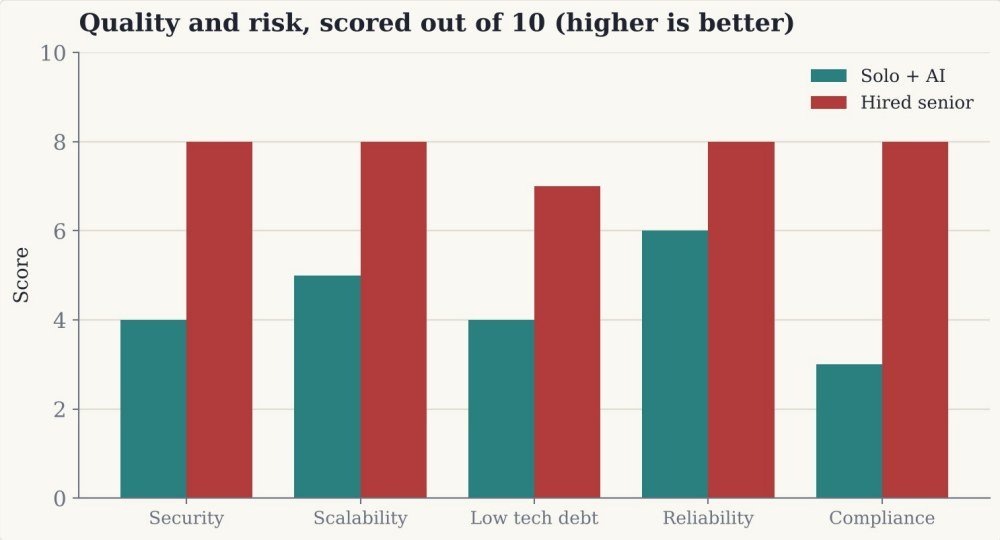
Across the dimensions where expertise matters most, security, scale, tech debt, and compliance, the solo build carries real and often invisible risk that a senior engineer reduces.
Part Eleven: Knowledge compounds when you build it yourself
We touched on this with the learning curve, but it deserves its own full treatment, because for a certain kind of builder it is the factor that overturns the entire analysis. When you build something yourself, you do not just produce the thing. You produce, as a byproduct, a permanent increase in your own capability. When you hire, you produce only the thing, and your capability is exactly where it started.
Think about what this means over a sequence of projects rather than a single one. The first time you build with AI, you are slow and you make mistakes and you pay the full learning cost. The second time, you are faster, because you are drawing on everything the first project taught you. By the fifth or sixth project, you have accumulated a deep, reusable fluency, a library of patterns and judgment and workflow that makes each new build cheaper and better than the last. Your capability is compounding, growing project over project.
The hired path has no such curve. Each project, you pay, the work gets done, and you learn essentially nothing transferable. Hire out your sixth project and you are no more capable than you were on your first. The money bought a result and left no residue. The chart contrasts these two trajectories. The solo line climbs steadily as retained capability accumulates. The hired line stays flat along the bottom, resetting to roughly zero each time, because the knowledge walked out the door with the contractor.
For a one time builder with a single product to ship and no intention of building again, this factor is irrelevant, and the analysis stays purely about cost and risk for that one project. But for a serial builder, someone who intends to create many products over years, the compounding capability is enormous and it tilts the whole decision hard toward building yourself, at least for the projects where the risk is survivable. Every solo build is simultaneously a product and an investment in your own future productivity. Every hired build is a product and nothing else. Over a career of building, that difference accumulates into a gulf, and it is the reason that many prolific builders would rather build ten things imperfectly themselves than hire out one thing perfectly. They are not just making products. They are compounding themselves.
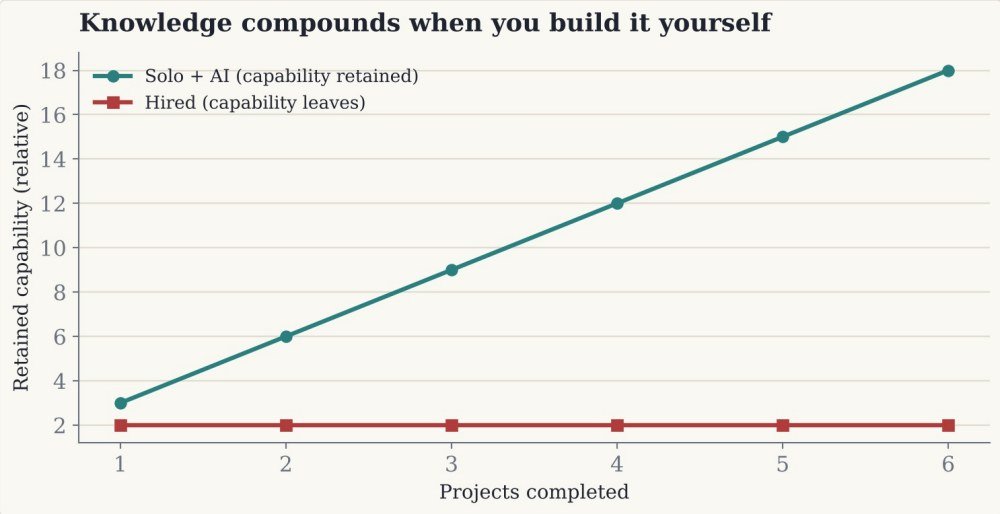
Build it yourself and your capability compounds across projects. Hire it out and the capability leaves each time. For serial builders, this gap grows into a gulf.
Part Twelve: Speed to market and the hard ten percent
Cost and capability are not the only things that matter. Sometimes what matters most is speed, how quickly you can get a shippable product in front of real users, because a window is open, a competitor is moving, or you simply need revenue sooner rather than later. On speed, the picture is more interesting than you might expect, and it depends heavily on the complexity of what you are building.
For simple products, the solo builder with AI is extraordinarily fast, often faster than hiring, because there is no onboarding, no handoff, no communication overhead, and no waiting for someone else's schedule. You have the idea and you build it, directly, immediately. A straightforward app that might take weeks to brief, contract, and hand off to an outside team can be built solo in days. Here, solo wins on speed as well as cost.
But as complexity rises, the advantage flips. The chart shows the pattern across three tiers. On a simple app, solo is quicker. On a medium app, the two are roughly even, as the solo builder starts to hit the limits of their fluency and the hired team's expertise starts to pay off. On a complex or regulated build, the hired team is meaningfully faster, because the hard parts, the real security, the architecture that will scale, the compliance machinery, are exactly where a non expert slows to a crawl and an expert moves confidently. The solo builder can get eighty or ninety percent of the way quickly, and then spend an agonizing stretch grinding through the hard ten percent that an experienced engineer would clear in a fraction of the time.
This hard ten percent is the crux of the speed story and, really, of the whole build or buy question. AI has made the easy ninety percent of most products nearly trivial to build. What it has not done is make the hard ten percent easy, and the hard ten percent is usually where the risk, the complexity, and the real engineering live. A builder who understands this does not ask simply build or buy. They ask which parts to build and which parts to buy, which leads directly to the approach that, for most serious products, beats both pure options.
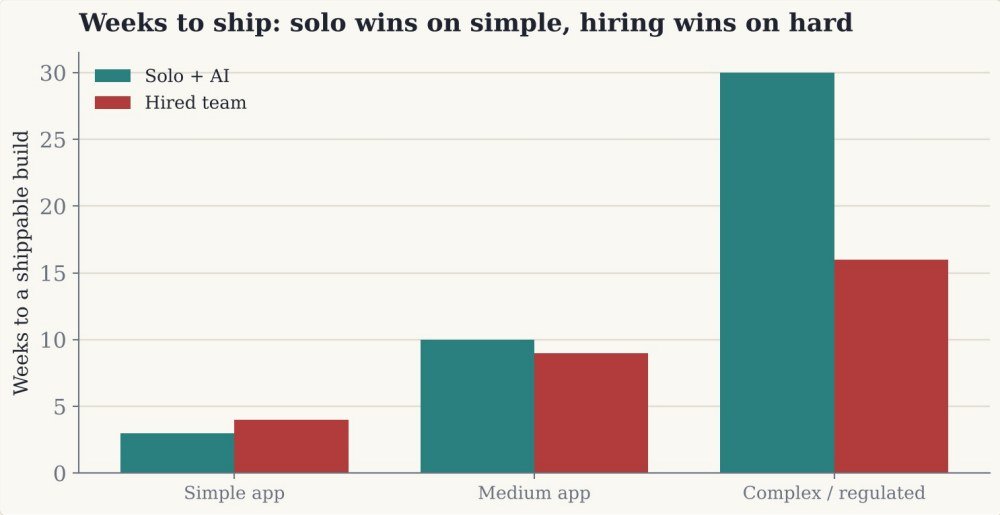
Solo is faster on simple builds. Hiring is faster on complex ones, because the hard ten percent, security, scale, and compliance, is where expertise clears the path quickest.
Part Thirteen: The portfolio builder's advantage
Everything changes when you stop thinking about a single project and start thinking about a portfolio, a sequence of products built over time. This is the situation of the serial builder, and it is where the solo path's compounding advantages, the amortized learning curve and the accumulating capability, combine into something decisive.
Consider the cost per app as the portfolio grows. On the solo path, each new app shares the one time learning investment with all the others, and each one is built faster and more cheaply than the last as fluency accumulates. So the cost per app falls steadily the more you build, as the fixed costs spread thinner and the per project effort drops. On the hired path, there is no such economy. Each app costs roughly the same as the last, because you are paying full freight every time and retaining nothing. The cost per app stays flat no matter how many you build.
The chart shows these two trajectories, and the divergence is stark. The solo cost per app starts higher than you might hope, because the first app absorbs the learning curve, but it falls with each subsequent build. The hired cost per app runs flat and high across the whole portfolio. By the third or fourth app, the solo builder is operating at a cost per product the hired path can never approach, and the gap only widens.
This is why the economics of AI assisted solo building are so much more favorable for serial builders than for one time builders, and why the same analysis can point in opposite directions depending on how many things you plan to build. If you have exactly one product in you and will never build again, the per project comparison for that single project is what matters, and hiring may well win if the product is complex or your time is valuable. But if you are a builder by temperament, someone with a pipeline of ideas and the intention to ship many of them over years, the solo path's compounding makes it progressively more dominant with every project, and the early investment in learning becomes one of the highest return decisions you can make. The portfolio builder is not really choosing how to build one app. They are choosing whether to become capable of building all of them cheaply, forever.
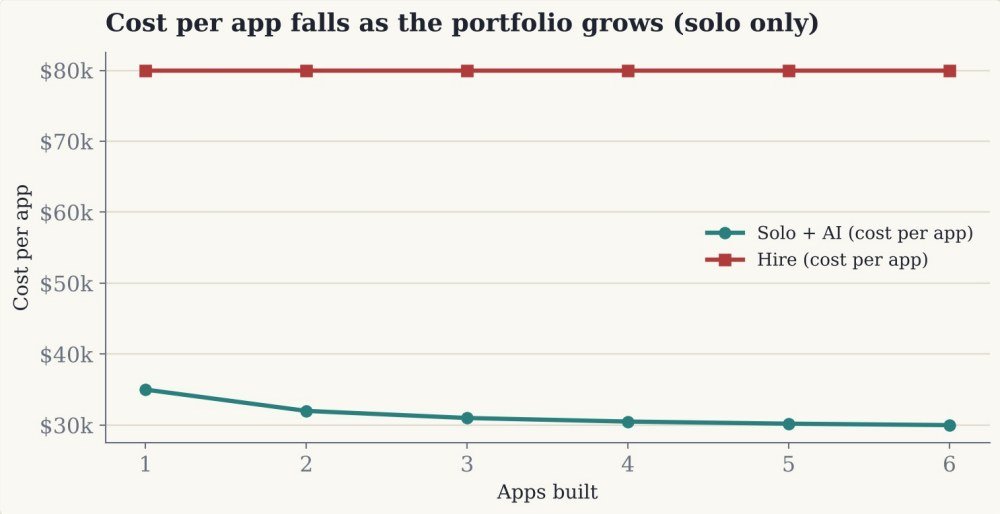
Across a portfolio, solo cost per app falls as learning amortizes and fluency grows. Hired cost per app stays flat and high. Serial building tilts the math hard toward solo.
Part Fourteen: The hybrid, which usually beats both
For most serious products, the smartest path is neither pure building nor pure hiring, but a deliberate blend of the two that captures most of the cost advantage of solo while buying back most of the safety of hired expertise. Call it the hybrid, and once you see it, the pure options start to look like false choices.
The structure is simple. You build the bulk of the product yourself with AI, the easy ninety percent that AI handles well, for almost nothing in cash. Then you spend a small, targeted amount of money, a handful of hours of senior engineering at $150 an hour, on exactly the parts where solo building is weakest and riskiest. A security review. An architecture check before you scale. A hardening of the authentication and the payment handling. A second set of expert eyes on the code the AI generated, specifically hunting for the plausible but wrong, the parts that look fine and are not.
The numbers on this are compelling. A full hired build might run $100,000 or more. Twenty to sixty hours of targeted senior review runs $3,000 to $9,000, a rounding error against the full hire, and it buys back precisely the quality and security that the solo path puts most at risk. The chart compares the three approaches on both cost and risk. Pure DIY is cheapest but carries the highest risk. Pure hire is safest but most expensive. The hybrid sits in the sweet spot, near the low cost of DIY and near the low risk of hiring, dominating both on the combined measure that actually matters.
The hybrid works because it respects the real shape of the problem, which is not uniform. A product is not equally risky and equally hard in all its parts. It is mostly straightforward, with a few concentrated zones of genuine danger. The pure solo builder underinvests in those zones and ships risk. The pure hirer overinvests everywhere, paying expert rates for the trivial parts too. The hybrid spends almost nothing on the easy bulk and concentrates its spending exactly where expertise earns its premium. For any product serious enough that failure is costly, this is usually the right answer, and it is the one the simple build or buy framing tends to hide.
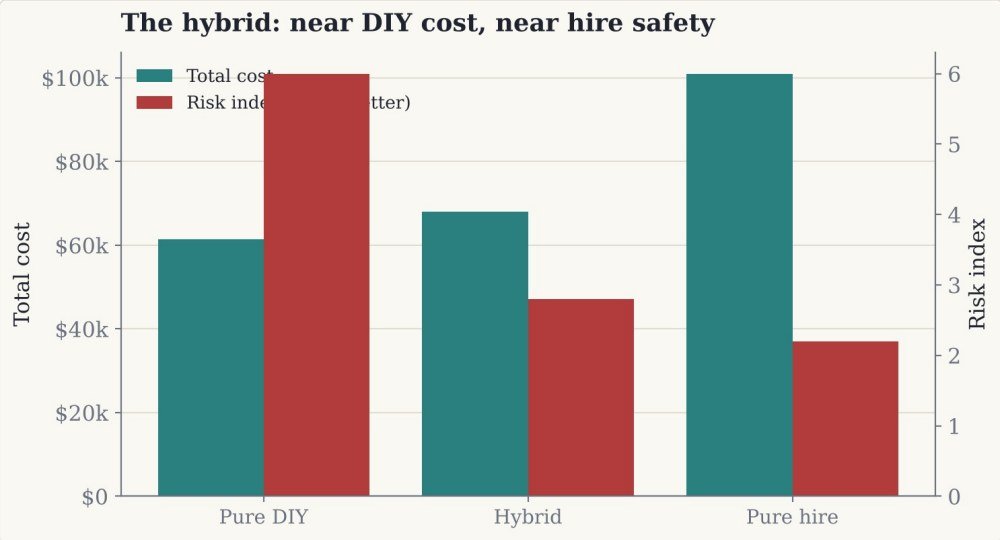
The hybrid captures most of DIY's low cost and most of hiring's low risk by building the easy bulk solo and buying targeted expert review of the dangerous parts.
Part Fifteen: The decision quadrant
We can now assemble everything into a single decision tool, because the whole analysis reduces to two questions whose answers place you in one of four zones. The first question is how much your time is worth, your opportunity cost per hour. The second is how complex and high stakes the project is, which governs both the risk and where the speed advantage lies. Plot those two axes against each other and the right answer falls out of which quadrant you land in.
In the lower left, where your time is relatively inexpensive and the project is simple and low stakes, the answer is build solo. This is the natural home of the learning builder, the side project, the straightforward tool. Cash is tight, the risk of a flaw is survivable, and the hours you spend are both cheap and an investment in your own capability. Build it yourself and keep the money.
In the upper left, where the project is complex or high stakes but your time is still relatively inexpensive, the answer is build plus review, the hybrid. Do the bulk yourself to save the cash, but hire targeted expert review of the dangerous parts, because the stakes make the quality risk real even though your time is cheap enough to justify doing most of the work. In the lower right, where the project is simple but your time is genuinely valuable, the answer leans toward delegating, because spending your expensive hours on trivial building is a poor use of your most valuable resource, even though the work is easy.
And in the upper right, where the project is both high stakes and your time is costly, the answer is hire. Here both forces point the same way. The complexity makes expert quality worth paying for, and your expensive time makes doing it yourself a poor trade. This is the clearest case for simply paying a tech company or a senior engineer and buying your way past the whole labor. The chart lays out all four zones. Find yourself on the two axes, read your quadrant, and you have your answer, grounded not in taste or ideology but in the two numbers that actually govern the decision.
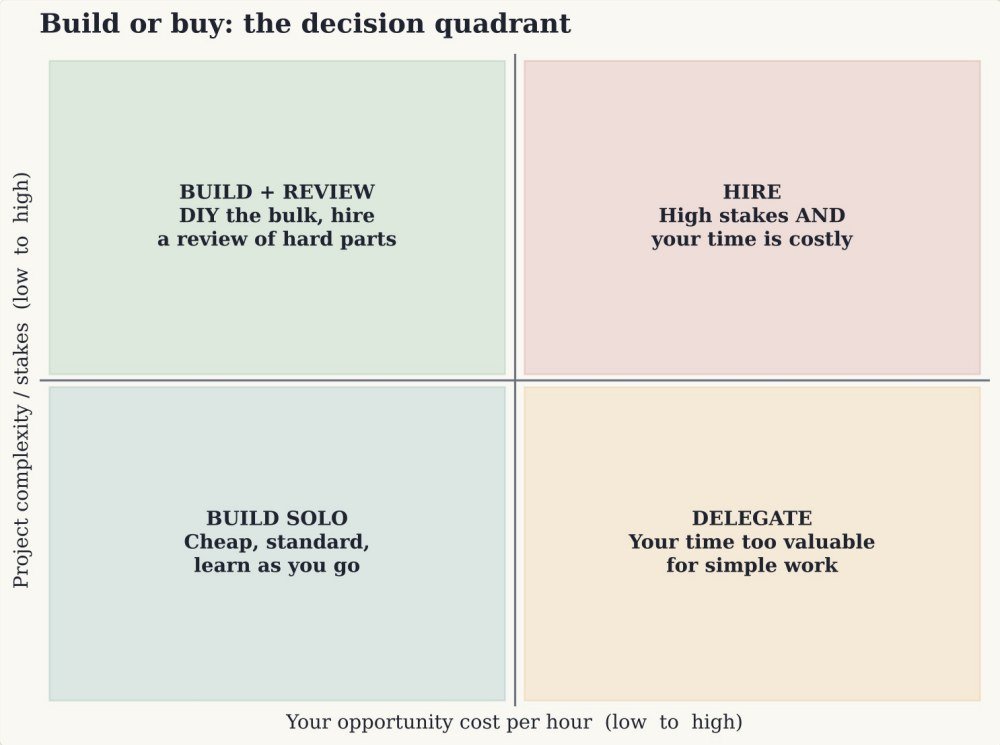
Two questions, your hourly value and the project's complexity, place you in one of four zones: build solo, build plus review, delegate, or hire. Find your quadrant.
Part Sixteen: Four builders, four answers
To make the framework concrete, consider four builders facing the same nominal choice and arriving, correctly, at four different answers, because their two numbers differ.
The first is a student or early career builder with lots of time, little money, and a simple app in mind. Their opportunity cost is low, perhaps $20 an hour, and the project is low stakes. They are deep in the lower left quadrant. For them, building solo with AI is overwhelmingly right. The cash they save is enormous relative to their means, the hours they spend are cheap and double as education, and the compounding capability they build will serve them for years. They should build, and they should not feel the slightest doubt about it.
The second is a busy professional, well paid in their field, who wants a side product but whose time is genuinely worth $150 an hour or more at their day job. The project is moderate. For them the math is harsh. Every hour on the build is an expensive hour foregone, and 900 of them is a six figure opportunity cost. Unless the building itself is the point, something they do for love or learning rather than pure output, they are better off hiring, or at minimum running a tight hybrid that minimizes their own hours. For them, the romance of building it all themselves is a luxury priced in their own scarce time.
The third is a serial builder, a person with a pipeline of products and the intention to ship many over years, whose time is worth a moderate amount, say $60 an hour. For them the portfolio effect dominates. Each solo build amortizes the learning further and compounds their fluency, driving the cost per product down and down. They should build the bulk themselves as a matter of long term strategy, reserving hired help for targeted review of the high stakes pieces. Building is not just how they make this product. It is how they become able to make all the next ones cheaply.
The fourth is a founder building something genuinely high stakes, a product handling payments or sensitive data or operating under regulation, regardless of their hourly value. For them the risk axis overrides everything. The invisible quality and security gap in a solo AI build is not an acceptable gamble when a flaw means a breach or a liability. They should hire real expertise for the dangerous core, whatever their time is worth, because the cost of getting it wrong dwarfs every number on every chart in this report. The right answer was never universal. It was always the output of each builder's own two numbers run through the same honest machine.
Conclusion: the two numbers that decide it
Strip away all the charts and the line items and the scenarios, and the entire build or buy question comes down to two numbers and one honest machine for combining them. The first number is what your time is actually worth, your true opportunity cost per hour. The second is how many hours this specific build will really take you, learning curve and scope creep and the hard ten percent all included. Feed those two numbers into the framework, against the complexity and stakes of what you are making, and the answer is no longer a matter of opinion. It is a calculation, and it is personal to you.
What the analysis reveals, underneath all the detail, is that the cash comparison everyone starts with is almost a distraction. Yes, building solo with AI is far cheaper in cash, often by a factor of ten or more. But cash was never the binding constraint. Time was, and time is the cost that AI's seductive cheapness hides most effectively. The flat, nearly free solo line in the very first chart was the most misleading number in the whole report, because it showed only the money and silently omitted the hours, and the hours are seven eighths of the real cost.
The deeper truth is that AI has made building cheap, but it has not made judgment cheap, and judgment is now the entire job. The machine will happily build forever, consuming your irreplaceable time one frictionless hour at a time, and it will not tell you when to stop, which corners are dangerous, or whether this was even worth building. Those decisions, protecting your hour count, knowing where the real risk lives, pricing your own time honestly, and recognizing when to hand the hard parts to someone who knows better, are what separate the builders who come out ahead from the ones who disappear into a year of pleasant, productive, output rich motion and emerge with nothing to show for it.
So price your hours. Estimate them honestly, then add the slippage you know is coming. Locate your quadrant. And remember the one line that holds the whole report together. The tools made almost everything cheap, except the only thing that was ever truly scarce, which is your time, and whether you build or buy, the real skill now is spending that one nonrenewable resource on the things that actually matter.


Discussion
React, reply, and talk it through with other readers.