Automatically translated · the author has not supplied this language
En Desprecio
In Contempt: A system built in the 1970s to recoup welfare money now fixes its debts in dollars that never rise, charges interest that does, and jails some of the poorest parents in America for failing to pay the impossible. This is why child support exists, who it imprisons, and how inflation turned a court order into a trap.
In 2008, a man named Michael Turner stood in a South Carolina courtroom without a lawyer and was sentenced to a year in jail. He had not robbed anyone or hurt anyone. He owed about six thousand dollars in back child support, and the judge, without ever deciding whether Turner actually had the money to pay, sent him to prison until he did. Turner had been down this road before. He had been held in contempt five times already, jailed again and again, each time for the same offense of being unable to afford a court order. His case would travel all the way to the Supreme Court of the United States, and it opens a question that sits at the heart of a system most Americans never think about until it reaches into their lives. How did a program built to recover welfare money end up jailing poor people for their poverty?
This is a case study of the American child support system. It asks three things. Why the system was built in the first place, and what it was really meant to do. How it came to put people in jail, and whether that works. And how inflation, the quiet force raising the price of everything, has turned a fixed debt into a trap that grows faster than the people caught in it can ever hope to pay.
$115B in unpaid child support owed to American families
70% of that debt owed by parents earning under $10,000 a year
1 in 6 U.S. children the system reaches
Why it was built
The idea that a parent should support a child is older than the country, but the idea that the federal government should enforce it is surprisingly new. For most of American history, child support was a private matter, settled between families or in local courts, and its roots run back through the English Poor Law to the notion that a needy person should turn first to relatives rather than to the public purse. 1 What changed that, and pulled Washington into the most intimate corner of family life, was not a sudden concern for children. It was money.
By the middle of the twentieth century, a growing number of single mothers were turning to welfare, then called Aid to Families with Dependent Children, and the government began to notice how much it was spending to support children whose absent fathers were contributing nothing. The response built slowly. A 1950 law first required states to notify authorities when welfare went to a child who had been abandoned by a parent, and later amendments added tools to track those parents down. 2 Then, in January 1975, President Gerald Ford signed the law that created the federal Child Support Enforcement program, and the modern system 2 was born.
It is worth being clear about what that system was designed to do, because the design still shapes everything about it. The program's central purpose was to reduce welfare spending by making absent parents, rather than taxpayers, pay to 2 raise their children. To receive welfare, a mother had to sign over her right to child support to the government, so that when the state collected from the father, the money did not go to the child at all. It went to reimburse the government for the welfare it had paid. 2 In other words, the system was born less as a children's program than as a debt collection program, one in which the original creditor was often the state itself. Ford himself signed it with open misgivings, warning that parts of it went too far by injecting the federal government into domestic relations. 2 His reservation would echo for the next fifty years.
The enforcement machine
Once the federal government was in the business of collecting child support, it steadily armed itself to do so, and the tools it gathered are formidable. A 1984 law, passed unanimously, required states to withhold support directly from paychecks, 3 to intercept tax refunds, to file liens, and to report debts to credit bureaus. A 1988 law made numeric support guidelines a presumption that a judge could override only with a written finding. 3 2 And in 1996, the sweeping welfare reform law bolted on the rest of the modern arsenal. 2
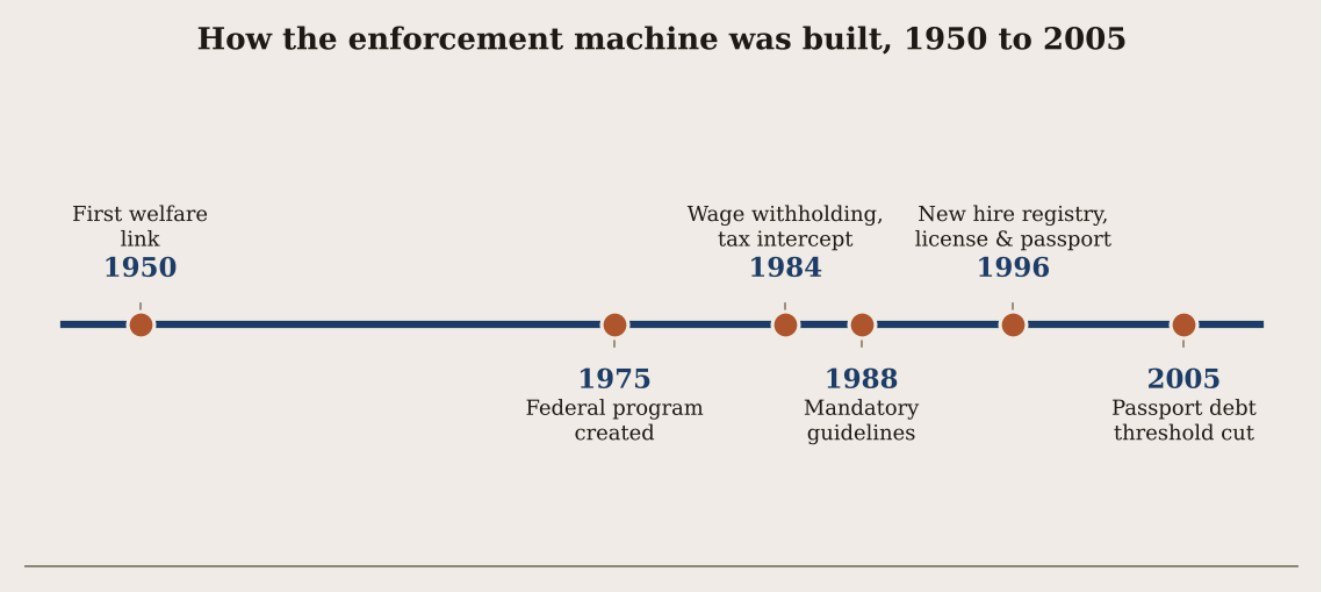
Five decades of federal law turned child support from a private family matter into a national collection system. Source: Congressional Research Service.
That arsenal is worth seeing in full, because it explains how ordinary the extraordinary has become. Today the government operates a national registry that flags a delinquent parent the moment they are hired for a new job, anywhere in 2 the country. It can suspend a person's driver's license, their professional license, 2 even their hunting and fishing licenses. It can deny or revoke a passport for anyone who owes more than twenty five hundred dollars. 2 It can reach directly into bank accounts, because financial institutions are required to report the 2 accounts of those who owe and to surrender the funds on demand. No private debt collector in America has powers remotely like these. The machinery is vast, and it works at enormous scale. In 2024 the program handled roughly 11.6 million cases and collected about 29.5 billion dollars, touching the lives of some 12.2 million children, which is to say about one in every six children in the United 4 5 States.
The striking thing, given all that power, is that the system has been shrinking rather than growing. As recently as 2020 it collected over 31 billion dollars and served nearly 14 million children, and both numbers have fallen since. 6 The welfare rolls that once justified the program have thinned, and most cases today, 4 more than half, involve families that have never been on public assistance at all. The great collection machine built to recoup welfare money now spends most of its energy moving support between private parents. But the machinery did not soften as its original purpose faded. It kept all its teeth, and nowhere are those teeth sharper than at the point where a parent cannot pay.
The case of Michael Turner
Return to that South Carolina courtroom, because Michael Turner's case is the clearest window into how the system jails people, and the Supreme Court's answer to it still governs the country. In 2003 a court ordered Turner to pay about fifty two dollars a week in child support. Over the next several years he fell behind, and the court reached for the oldest tool it has, the contempt power, holding him in contempt five separate times and jailing him repeatedly. Then, in 2008, it sentenced him to a full year behind bars for owing roughly six thousand dollars, after a hearing at which he had no lawyer and the judge made no finding that he 8 was actually able to pay.
$6,000
the back child support that sent Michael Turner to jail for a
year, with no finding that he could pay it
The legal mechanism that put him there is worth understanding, because it is strange. Turner was not convicted of a crime. He was held in civil contempt, a tool meant not to punish but to coerce, built on the old idea that the jailed person holds the keys to his own cell and will be freed the moment he complies. 7 But that logic only works if the person can comply. A civil contempt hearing lacks the protections of a criminal trial. There is no presumption of innocence, no automatic right to a lawyer, and a court may even place the burden on the parent to prove 7 that he cannot pay, rather than on the state to prove that he can. A man with no money and no lawyer can be asked to prove a negative about his own poverty, and if he fails, he goes to jail.
When Turner's case reached the Supreme Court in 2011, the Court tried to thread a needle, and the result satisfied no one completely. It held that the Constitution does not automatically require the government to provide a lawyer to a poor person facing up to a year in jail for child support contempt, at least where the other parent also has no lawyer. 8 But it also held that the state cannot simply jail someone without some protections, and it required a set of safeguards instead, chief among them that the court must actually ask whether the person can pay, give them a form and a chance to explain their finances, and make an express finding of ability to pay before locking them up. 8 Turner had received none of that, so his imprisonment was unconstitutional, and the Court set it aside. The decision was meant to be a compromise. In practice it guaranteed the poor no lawyer while trusting busy local courts to supply the safeguards on their own, and those safeguards, including the all important finding that a person can actually pay, are honored unevenly across the thousands of courtrooms where these cases are heard.
Dead poor, not deadbeats
The enduring image behind all of this is the deadbeat, the parent who could pay but selfishly will not, and that image is what makes jailing feel just. The data tell a more uncomfortable story. When researchers examined who actually owes the nation's child support debt, they found it concentrated not among the comfortable but among the destitute. In a landmark federal study, about seventy percent of all arrears were owed by people who reported either no income at all or income of 9 ten thousand dollars a year or less. Among those low earners, the typical child support order consumed an impossible eighty three percent of their reported 9 income, while the typical payment they managed came to just seven percent.
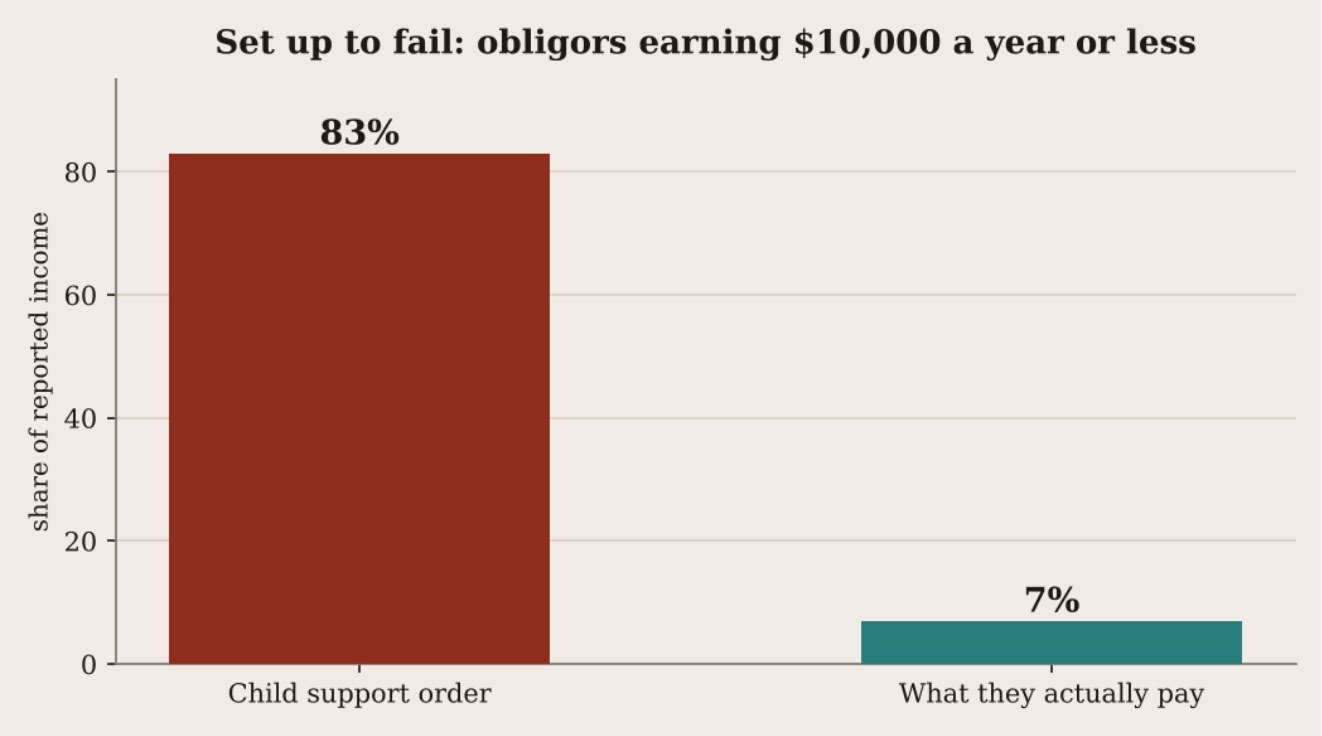
For the poorest obligors, the child support order demands most of their reported income, far more than they can actually pay. Source: Urban Institute for HHS, 2007. These were not people hiding yachts. For the most part they were, in the memorable phrase of one congressional report, dead poor rather than deadbeat, turnips from which no blood could be drawn. [7] Even at the extreme top of the debt, among parents owing more than a hundred thousand dollars, a majority reported no income whatsoever. [10] The burden also falls unevenly along the color line, though the data here are narrower and must be read with care. In one detailed study of nonpayment hearings across several years, researchers observed that roughly eighty percent of the parents hauled in for failing to pay were men of color, and predominantly Black men. 10 The authors were careful to say their study was not a national census, but it points at a pattern that other evidence supports, in which the same men most likely to face unemployment and a criminal record are the men most likely to fall behind and then to be punished for it.
And punishment, here, tends to defeat itself. Jailing a parent who cannot pay does not produce the money. It destroys the means of producing it. A person in jail earns nothing, and a person with a fresh criminal record earns less when they get out, yet the support order keeps running the whole time they are locked up, piling arrears and interest onto a debt that was already unpayable, which makes the 7 next jailing more likely, not less. By one federal estimate, less than two percent of all child support collected can even be attributed to the threat of incarceration, which means the system inflicts an enormous amount of harm to squeeze out a trickle of money. 7 No one even knows how many people are jailed this way each year, because no agency counts. The figure most often repeated, that some fifty thousand sit in jail for it, is an estimate that the government itself has never 7 verified.
What the numbers cannot capture, a single death can. In April 2015, a man named Walter Scott was shot in the back and killed by a police officer as he fled a traffic stop in North Charleston, South Carolina. Scott had been arrested before on contempt charges tied to unpaid child support, and his family believed that the fear of being jailed again was part of what made him run. 11 The causal link can never be proven, and it should not be overstated. But the case made visible a terror that the statistics keep hidden, the particular dread of a parent who has learned that falling behind on a payment can cost him his freedom, and who runs from a routine stop as though his life depends on it. 11 12
The debt that never shrinks
Follow the money far enough and you arrive at a mountain. At the end of the 2023 fiscal year, American parents owed roughly 115 billion dollars in past due child support to the families they were supposed to be supporting. Against that mountain, the amount actually paid down in the year was about seven and a half 4 billion. The debt is not a passing backlog that the system is slowly clearing. It has hovered between about 110 and 118 billion dollars for well over a decade, a vast and stubborn sum that barely moves no matter how many licenses are pulled 4 13 or parents jailed. The obvious question is why a debt so aggressively enforced refuses to come down, and the answer has two parts, and the second of them is inflation.
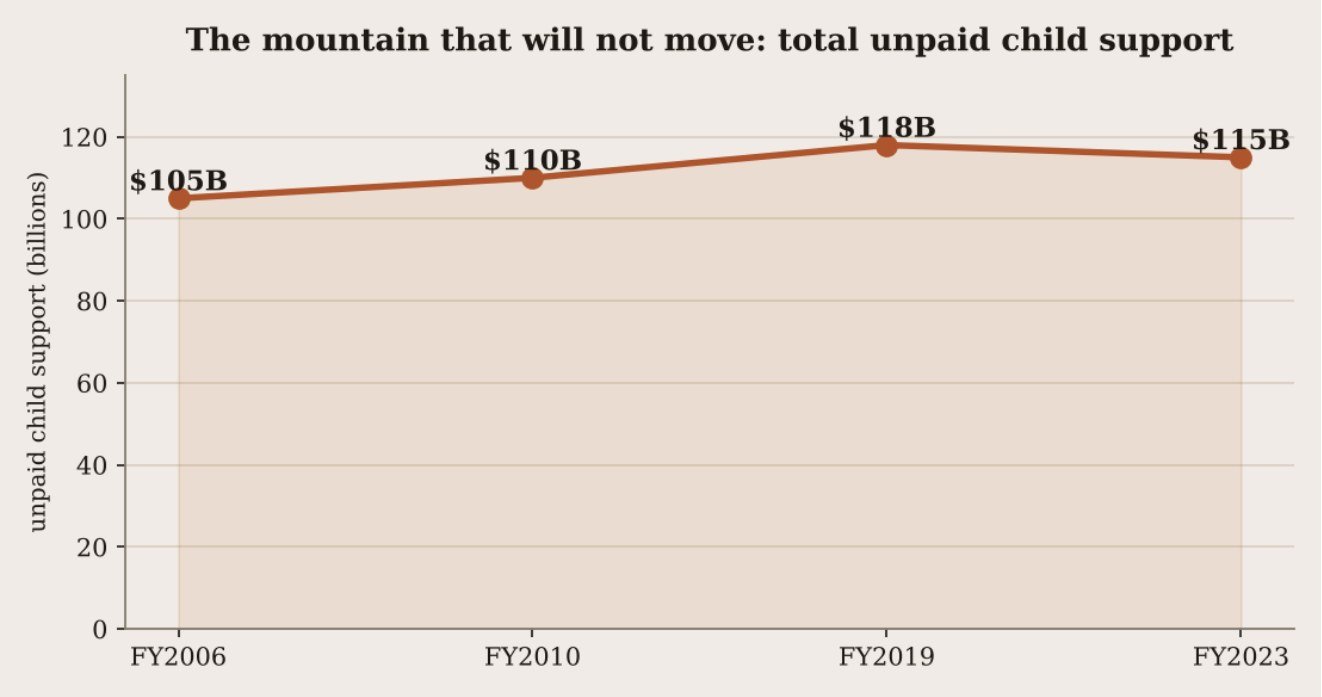
Despite aggressive enforcement, total unpaid child support has sat near $115 billion for more than a decade. Sources: Congressional Research Service; Institute for Research on Poverty.
The first part is interest. In many states, falling behind on child support does not merely leave you owing the missed payments. It starts a meter running. States set their own rules, and they vary enormously, from places that charge no interest at 14 all to states that add six, nine, even twelve percent a year to the unpaid balance. Where the meter runs fast, it can come to dominate the debt. In one careful study of Wisconsin cases, interest alone accounted for roughly half of the average arrears balance, which is to say that half of what these parents owed was not support for any child but a surcharge for having been poor on a schedule. 13 When a debt was already beyond a person's means, adding compound interest does not encourage payment. It simply guarantees that the debt will outlive any realistic hope of clearing it.
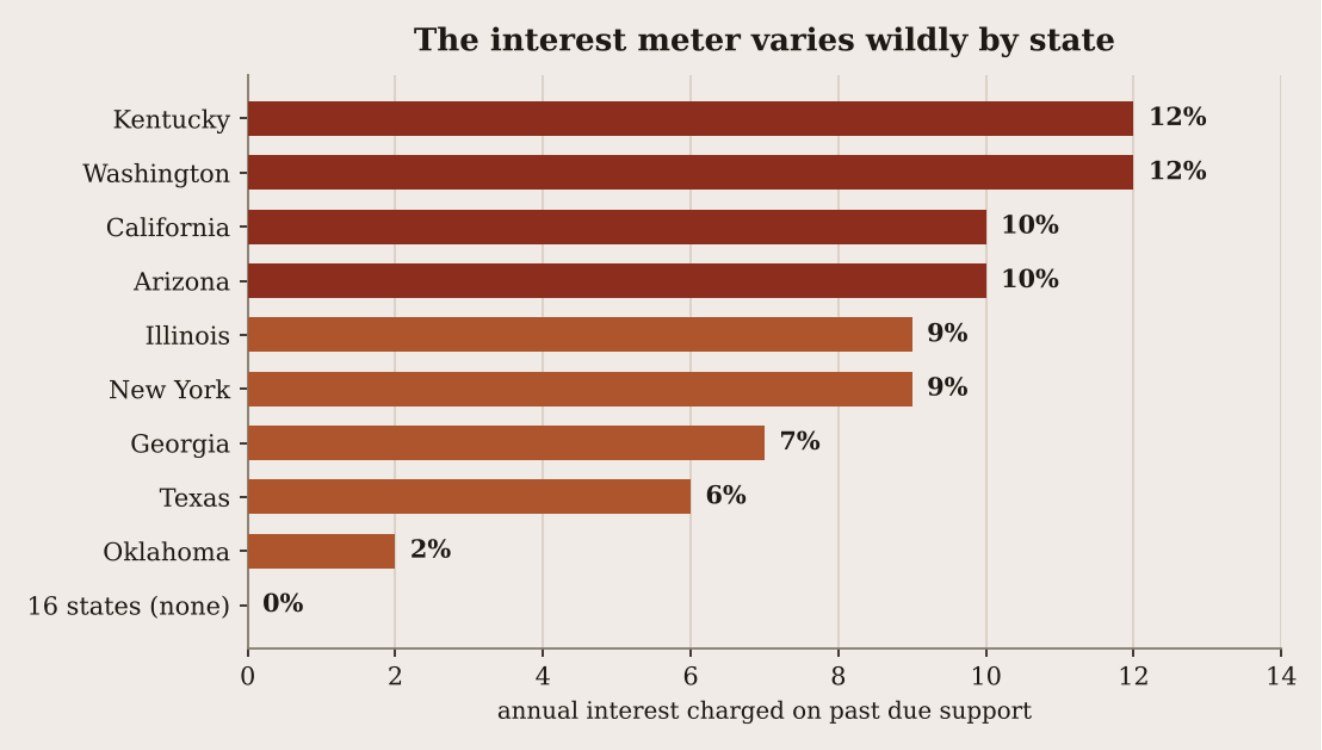
Whether a missed payment compounds into a growing debt depends entirely on the state. Source: National Conference of State Legislatures.
The second part, and the one most invisible, is that the whole system is built in fixed dollars while the world around it inflates. A child support order is a number, set on a particular day, and it does not rise with the cost of living. The law requires these orders to be revisited only on a slow cycle, no more than about once every three years in practice, and in most cases only when one of the parents asks, with 4 no automatic adjustment for inflation written into the system at all. That single design choice quietly harms both sides of every case. For the parent raising the child, a fixed order loses real value every year that prices climb, so the same check that once covered the groceries and the shoes covers less and less, even as the child grows and costs more. For the parent paying it, a fixed order written when rent and gas were cheaper grows heavier each year as everything else in their life gets more expensive, until a payment that was once manageable slips out of reach, the meter starts, and the road to the courtroom opens again.
The gap this opens is not small, because the cost of a child has been climbing fast. The last time the federal government measured it, the Department of Agriculture estimated that raising a child born in 2015 to the age of seventeen would cost 15 about 234 thousand dollars, and that figure did not even include college. When economists updated that number a few years later to account for the inflation that followed, they put the real cost above 310 thousand dollars. 16 That jump, more than 75 thousand dollars in a handful of years, is the precise space that inflation pries open between what a fixed order was set to provide and what a child actually needs. The order stays frozen. The child does not.
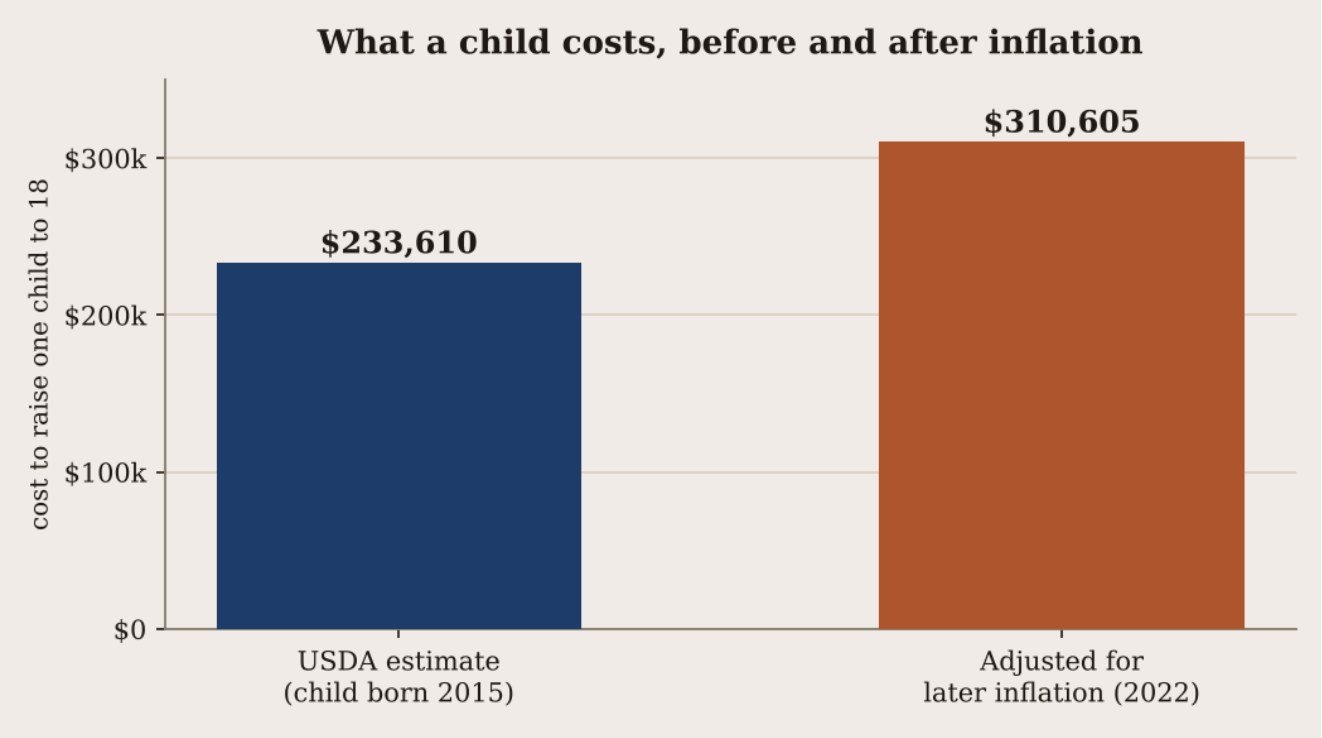
The last official USDA estimate, updated for the inflation that followed, shows how fast the real cost of a child has risen. Sources: USDA, 2017; Brookings Institution, 2022.
There is one more quiet shift worth noting, because it reveals what the system has become. The debt was originally meant to flow back to the government, to repay the welfare it had spent. As recently as 2002, about half of all arrears was owed to the state rather than to families. By 2013 that share had fallen to roughly a quarter, and most of the mountain was now owed to parents and children directly. 17 The program has drifted, case by case, away from the welfare recovery it was built for and toward the private support of children. But the hard machinery it was given for the first job, the interest, the license suspensions, the contempt power, the jail cell, was never recalibrated for the second. It still collects a private debt with the force once reserved for a public one.
What the case reveals
Put the three threads together and the shape of the thing becomes clear. A system was built in the 1970s to recoup welfare money from absent parents. It armed itself, over the following decades, with powers no private creditor could dream of. And because it fixes its debts in dollars that never rise while charging interest that does, and enforces them against people who are often genuinely unable to pay, it manufactures a permanent mountain of unpayable debt and then, at the bottom of the process, puts some of the poorest people in the country in jail for failing to shrink it. None of this was anyone's plan. Each piece, the welfare recovery, the enforcement tools, the interest, the contempt power, was added for a reason that made sense at the time. The cruelty is in the sum.
There are ways out, and some are already being tried. Courts can be made to honor the one protection the Supreme Court did require, an honest finding of whether a person can actually pay before jailing them. States can cut or cancel the interest that turns hardship into a trap, as the evidence from Wisconsin suggests actually works. Orders can be set realistically against real incomes, and adjusted as prices change, so that the debt tracks what a parent can pay rather than what a child abstractly costs. None of these would weaken the genuine duty at the center of all this, which is that a parent should support their child. They would only stop the system from punishing poverty as though it were refusal. Michael Turner's daughter did not need her father in a cell. She needed what every child in this story needs, which is support that is real, from a parent who is able to give it, in a system wise enough to tell the difference between a parent who will not pay and one who simply cannot.
Sources
1. Daniel R. Mandelker, Family Responsibility Under the American Poor Laws, 54 Michigan Law Review 497 (1956). https://repository.law.umich.edu/mlr/vol54/iss4/3 2. Congressional Research Service, The Child Support Enforcement Program: A Legislative History (R44423), 2016. https://www.everycrsreport.com/reports/R44423.html 3. Congressional Research Service, Child Support Enforcement: Summary of Laws Enacted Since 1950 (R47630), 2023. https://www.everycrsreport.com/reports/R47630.html 4. Congressional Research Service, Child Support Enforcement: Program Basics (RS22380). https://w ww.everycrsreport.com/reports/RS22380.html 5. Office of Child Support Services, FY2024 Preliminary Data Report and Tables. U.S. Department of Health and Human Services, Administration for Children and Families. https://acf.gov/css/policy-guid ance/fy-2024-preliminary-data-report-and-tables 6. Office of Child Support Enforcement, FY2020 Annual Report to Congress. U.S. Department of Health and Human Services. https://acf.gov/css/report/fy-2020-annual-report-congress 7. Congressional Research Service, Child Support Enforcement: Incarceration As the Last Resort Penalty for Nonpayment of Support (R42389), 2012. https://www.everycrsreport.com/reports/R42389. html 8. Turner v. Rogers, 564 U.S. 431 (2011). U.S. Supreme Court. https://law.justia.com/cases/federal/us/ 564/431/
9. Elaine Sorensen, Liliana Sousa and Simone Schaner, Assessing Child Support Arrears in Nine Large States and the Nation. Urban Institute, for HHS, 2007. https://aspe.hhs.gov/execsum/assessing -child-support-arrears-nine-large-states-and-nation 10. Tonya L. Brito, David J. Pate Jr. and Jia-Hui Stefanie Wong, Negotiating Race and Racial Inequality in Family Court. Institute for Research on Poverty, Focus 36(4), 2020. https://www.irp.wisc.edu/wp/wp -content/uploads/2021/01/Focus-36-4b.pdf 11. Eli Hager and Dana Goldstein, Why Was Walter Scott Running? The Marshall Project, 10 April 2015. https://www.themarshallproject.org/2015/04/10/why-was-walter-scott-running 12. Caught on video, white cop charged with murdering black man. PBS NewsHour, April 2015. http s://www.pbs.org/newshour/nation/caught-video-white-cop-charged-murdering-black-man 13. Quentin H. Riser and Daniel R. Meyer, Reducing the Interest Rate Charged on Arrears. Institute for Research on Poverty, University of Wisconsin Madison, December 2023. https://www.irp.wisc.edu/ resource/reducing-the-interest-rate-charged-on-arrears 14. National Conference of State Legislatures, Interest on Child Support Arrears. https://www.ncsl.or g/human-services/interest-on-child-support-arrears 15. Expenditures on Children by Families, 2015. U.S. Department of Agriculture (released January 2017). https://www.fns.usda.gov/cnpp/expenditures-children-families 16. Morgan Welch and Isabel Sawhill, It's getting more expensive to raise children, and government isn't doing much to help. Brookings Institution, 30 August 2022. https://www.brookings.edu/articles/it s-getting-more-expensive-to-raise-children-and-government-isnt-doing-much-to-help/ 17. A Major Change in Who Is Owed Child Support Arrears. Office of Child Support Enforcement, HHS, 2014. https://peerta.acf.hhs.gov/content/major-change-who-owed-child-support-arrears


Discussion
React, reply, and talk it through with other readers.