The Frogman: The Study They Tried to burry - Atrazine
Silencing the Research: Dr. Tyrone Hayes and the burial of credibility
The Frog Man, the Weed Killer, and the Fight They Tried to Bury
A COLUMN · ABOUT A 30 MINUTE READ · OCTOBER 2026
I. The click on the line
B y 2001, Tyrone Hayes had started teaching his students a particular kind of listening. If they were on a lab phone and heard a faint click mid sentence, they were to hang up. He carried a tape recorder into meetings because he had noticed that other scientists seemed to remember the same conversations differently than he did. He told people, half as a joke and half not, that the trick to a happy life of paranoia was to keep careful track of who was after you.
He was thirty four years old, a tenured professor of integrative biology at the University of California, Berkeley, raising three thousand frogs in his lab. A senior colleague had once said Hayes may have had more raw potential than anyone in his field. And he had arrived at a place where he believed (correctly, as it would turn out) that one of the largest agrochemical companies on earth was following him to conferences, studying his marriage, and working to end his career.
This is the part of the story people find hard to hold in their heads. The paranoia was justified. The documents exist. They came out in court. And the thing that set all of it in motion was a frog with the wrong body.
II. A harmless little job
Back up to the summer of 1997. Hayes was a young assistant professor, newly hired, already with roughly twenty published papers on amphibian hormones to his name. He got what looked like an easy, lucrative offer. Join a panel of scientists, funded by the maker of a herbicide called atrazine, to study whether the chemical did anything to frogs.
Atrazine is not a niche product. It is sprayed on more than half the corn grown in the United States, and used widely on golf courses and Christmas tree farms. It is one of the most heavily used herbicides in the country. The company paying for the research was Novartis's agribusiness arm, which would soon merge into the Swiss giant Syngenta .
Hayes's own expectation going in was flat. Nothing's going to happen. He figured he would run the experiments, find no effect, cash the checks, and move on.
Instead, the frogs started coming out wrong.
III. What he actually saw
The first odd thing was the voice box. In male frogs exposed to atrazine, the larynx, the organ they use to call for mates, was not growing the way it should. In a frog, that is not cosmetic. A male that cannot call properly cannot reproduce.
Then it got stranger. Looking more closely, Hayes found that roughly a third of the male frogs exposed to atrazine had developed abnormal reproductive organs. Males carrying ovarian tissue inside their testes. Hermaphrodites. Some were effectively intersex.
And here is the detail that made the finding genuinely alarming rather than merely weird. The doses doing this were tiny. The amounts that were turning some of his frogs into hermaphrodites were far below the federal “safe” limit for atrazine in human drinking water. That limit is 3 parts per billion, and Hayes was seeing effects at a fraction of that. He would later report changes at 2.5 parts per billion. To put the scale in human terms, that is on the order of a few drops in an Olympic swimming pool.
The mechanism he proposed. Atrazine is an endocrine disruptor. It does not poison the frog outright. It scrambles the hormonal signals that tell a developing body whether to become male or female. His conclusion was that atrazine demasculinizes male frogs and pushes them to display female characteristics.
Years later, in his most cited and most contested experiment, he pushed the claim to its limit. In 2010 Hayes published work describing complete sex reversal, genetically male frogs becoming females capable of mating with other males and producing eggs. About one in ten of the exposed males, he reported, behaved like females, even releasing the chemical signals that attract other males.
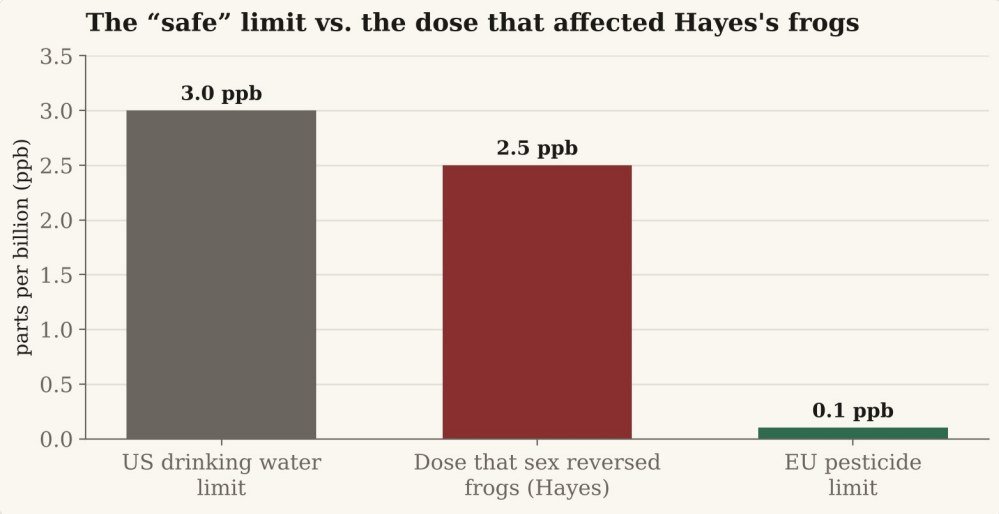
The core tension in three bars. Hayes reported effects at 2.5 ppb, below the 3.0 ppb the US still calls safe for human drinking water. Europe's limit for any single pesticide is 0.1 ppb, thirty times stricter than the US, and twenty five times below Hayes's effect dose.
IV. The part where he was told to be quiet
Here is where a chemistry story becomes a human one.
When Hayes brought these results back, the enthusiasm from his funders evaporated. The findings were not what the manufacturer expected. Atrazine causing sexual abnormalities in frogs, with the implication that it might do something similar in people. And the company declined to let him publish them.
Think about what that means in practice. Hayes was a scientist who had found something and could not say it. His own account is that the company first tried to simply buy the data outright. Before anything was published, and before the federal government got involved, the company tried to purchase the data. It eventually took the EPA insisting that the manufacturer release Hayes from his confidentiality contract.
So in November 2000, Hayes did the thing that defined the next quarter century of his life. He walked away from the company, ended the relationship, and resolved to keep studying atrazine on his own. He re ran the experiments on his own funding, free of any nondisclosure obligation, and in 2002 he published.
That decision (I will redo this with my own money so no one can tell me to shut up) is the moral spine of the whole saga. It is also what made him a target.
V. “Just because you're paranoid…”
For years, Hayes told colleagues he thought the company was running a campaign against him. Planting hecklers at his talks, trailing him from conference to conference, digging for anything that could be used to discredit him. It sounded, to many people, like a man who had lost perspective. A brilliant scientist curdling into conspiracy.
Then the documents came out.
In 2004, a small water district in Illinois, the Holiday Shores Sanitary District, sued Syngenta, arguing the company should pay to clean atrazine out of municipal drinking water. That case, and the larger class action that followed, forced open the company's internal files through discovery. Hundreds of pages of memos, invoices, and internal planning documents from Madison County, Illinois, originally sealed, were eventually unsealed, some in response to a Freedom of Information request by the investigative nonprofit 100Reporters.
What they showed turned the “paranoid professor” narrative inside out. The records laid out an aggressive, multimillion dollar campaign that included hiring a detective agency to investigate scientists on a federal advisory panel, looking into the personal life of a judge, and commissioning a psychological profile of the leading scientist criticizing atrazine. That scientist was Hayes.
The point man on the Hayes side of things appears repeatedly. Sherry Ford , a Syngenta communications manager, whose notes read like a battle plan. Her lists of ways to undermine him included publishing third party critiques of his science, issuing systematic rebuttals every time he appeared anywhere, making his emails public, contacting Berkeley, and, chillingly, “investigate wife.” In 2005 she compiled an even longer menu. Have his work audited by a third party, ask journals to retract him, “set trap to entice him to sue,” investigate his funding, investigate his wife, with employees' initials in the margins, apparently marking who was assigned to each task.
The hecklers were real, too. A former student recalled that everywhere Hayes went, there was a man at the back of the room asking questions designed to make a mockery of him. They nicknamed him “the Axe Man.” A Syngenta spokeswoman later confirmed that a company representative did try to attend Hayes's events.
And the smear was built to live online. Syngenta bought Hayes's own name as a search keyword, so that Googling “Tyrone Hayes” would surface a sponsored ad reading “Tyrone Hayes Not Credible.” Years later it was still there.
There was even an idea that reads, in hindsight, like dark comedy. According to the internal records, the company at one point entertained offering to “cut him in on unlimited research funds,” essentially, pay for all the atrazine research he could want, presumably on the understanding he would ease off. They also tried to make sure he could not go anywhere. The documents indicate Syngenta contacted Duke University to try to ensure it did not hire Hayes.
The full account came together in February 2014, when The New Yorker ran Rachel Aviv's profile of roughly 8,000 words, “A Valuable Reputation,” which used the court documents to put both halves of the story side by side. The internal files, Aviv reported, showed that Syngenta was probably just as preoccupied with Hayes as he was with them. The company had been studying the man while he studied the chemical.
VI. The ugly middle. Hayes was not a tidy martyr
A column that only told you the above would be propaganda. So here is the complicating truth.
Hayes did not conduct himself like a serene victim. As the pressure mounted, he fired off emails to Syngenta scientists that were taunting, profane, sometimes written in a bravado laced, rap inflected voice. The company seized on them. Syngenta filed an ethics complaint with Berkeley, calling his emails aggressive, unprofessional, and insulting, and released more than a hundred pages of them. The messages went viral. But Berkeley's chief counsel reviewed them and ruled that no ethics violations had occurred.
The New Yorker profile did not sand this down either. Its portrait was of a scientist who was genuinely brilliant and idealistic but also, at times, self aggrandizing, insecure, and lacking the clinical detachment that academia treats as professionalism. The honest read is that Hayes handed his opponents some of their ammunition. A disciplined man might have stayed colder. He did not.
Two things can be true at once. The company ran a documented campaign against him, and he was a difficult, combative figure who sometimes made himself an easier target. The reason the story endures is that the first truth does not depend on the second. The hecklers and the psychological profile and “investigate wife” do not become acceptable because the man they targeted sent rude emails.
VII. The counter case, stated fairly
Syngenta's position has never been “we did nothing.” On the science, specifically, the company and a number of regulators have made a real argument, and it deserves to be on the page.
The company's consistent line. It stands by the safety of atrazine, says the chemical does not cause adverse effects to human or environmental health at real world exposure levels, and calls it a well tested, beneficial product critical to agriculture.
The stronger part of the skeptics' case is replication. Independent and company funded teams have tried to reproduce Hayes's frog results and come up short. A study requested by the EPA and funded by Syngenta was unable to reproduce his findings. And the US regulator did not simply rubber stamp him. The EPA and its independent Scientific Advisory Panel reviewed the available studies, including Hayes's, and concluded there were “currently insufficient data” to determine whether atrazine affects amphibian development, recommending specific improvements to study design. Syngenta then ran two experiments under Good Laboratory Practices, inspected by US and German regulators.
For years the agency's formal conclusions leaned the company's way. The EPA had stated the pesticide residues posed “a reasonable certainty of no harm,” in 2007 said atrazine did not adversely affect amphibian sexual development, and in its 2009 review called its scientific basis for regulating atrazine “robust.”
A fair minded reader has to sit with the uncomfortable possibility that Hayes's specific, dramatic claims, especially full sex reversal, may be real, may be partly real, or may be an effect that only shows up reliably in his particular lab conditions. Replication is the currency of science, and on that currency his most spectacular results have never fully cleared.
But (and this is the pivot) “we could not replicate his frog study” is not the same as “atrazine is safe.” Those are two different questions, and the regulatory record has been quietly drifting toward Hayes on the second one even while staying agnostic on the first.
VIII. Follow the water
Strip away the personalities and one physical fact remains. Atrazine does not stay where it is sprayed. It runs off fields into streams and soaks down into groundwater, and conventional water treatment plants are not built to pull it out. By 2001 it was the most commonly detected pesticide contaminating drinking water in the United States.
Europe looked at the same chemical and reached a blunt conclusion. The EU banned atrazine in 2004, after finding groundwater levels above regulatory limits, when Syngenta could not show either that the contamination could be prevented or that those levels were safe. The European standard is strict almost to the point of being absolute. No single pesticide may exceed 0.1 micrograms per liter in drinking water, and atrazine kept blowing past it. The EU wide ban was foreshadowed by earlier national bans in corn heavy Germany and Italy back in 1991, after contamination in northern Italy's Po region forced local water plants to shut down.
Europe pulled atrazine off the market two decades ago. The United States still sprays it on most of its corn.
IX. Where it stands right now (2024 to 2025)
This is not settled history. The regulatory fight is active, and recent movement has gone against the chemical. The key number is the CELOC , the concentration equivalent level of concern, the atrazine level in water above which the EPA expects damage to aquatic plant communities, which in turn ripples up through fish, invertebrates, and amphibians.
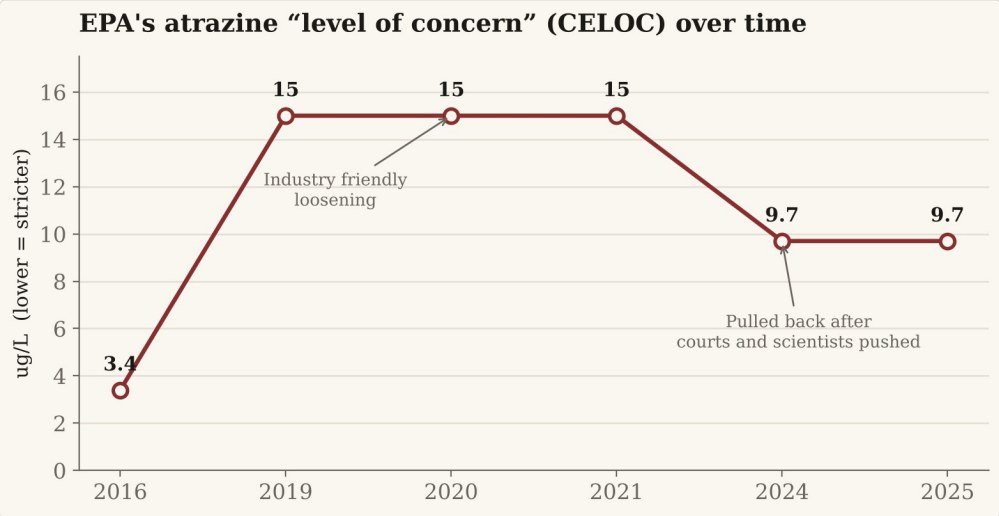
A regulatory tug of war. A lower number is stricter. Caution in 2016 (3.4), a big industry friendly loosening in 2019 (15), then a partial pullback toward caution in 2024 (9.7) after courts and scientists pushed.
In 2016 , the EPA's own ecological risk assessment set the science based level of concern at 3.4 micrograms per liter , the point past which there is a greater than 50 percent chance of harming an aquatic environment.
In 2019 , under a different administration, the agency set the trigger far looser at 15 micrograms per liter , more than four times more permissive, and finalized an interim decision on that basis in 2020.
That looser number was challenged. In December 2021 the Ninth Circuit granted the EPA a voluntary partial remand to reconsider it.
After a 2023 peer review, in July 2024 the EPA announced a revised level of concern of 9.7 micrograms per liter , to protect aquatic plants, fish, invertebrates, and amphibians.
In December 2024 the EPA proposed updated mitigation measures built around that revised 9.7 level.
Translation for a nonspecialist. The number bounced from cautious (3.4) to industry friendly (15) and then was pulled back toward caution (9.7) after courts and scientists pushed. Regulation here is a tug of war, and the rope keeps moving.
And it is still being litigated. In April 2025, environmental groups went to the Ninth Circuit arguing the EPA had dragged its feet for years, pointing out that several US watersheds already contain atrazine above the agency's own level of concern, meaning the EPA knows its benchmarks are being exceeded, and asking the court to force a revised decision. Twenty eight years after a young professor took a “harmless” consulting gig, the United States still has not issued a final answer on the chemical he studied.
X. Why this story matters beyond the frogs
The reason this one lodges in people is that it is not really a science story. It is a story about what happens to a person who finds something inconvenient and refuses to un find it.
Hayes could have taken the money. He could have let the data be bought. He could have published something softer, hedged, career safe. Instead he re ran the work on his own dime specifically so no contract could gag him, and then absorbed fifteen years of being followed, profiled, heckled, and advertised against as “not credible,” with his wife named in someone's planning notes.
The campaign against Hayes did not require anyone to break an obvious law. It ran on tools that look mundane one at a time. A PR retainer, a conference ticket, a keyword ad buy, an ethics complaint, a literature critique commissioned from friendly third parties. Syngenta kept a roster of “supportive third party stakeholders,” and some of the output was designed to look like journalism rather than public relations. That is the part worth sitting with. The most effective way to discredit a finding is rarely to argue the data. It is to make the public unsure whom to trust, and to make the messenger tired.
Hayes's own summary of his position never got more complicated than this. He believed the weight of the evidence showed atrazine to be a risk to wildlife and to humans, pointing to effects reported across fish, frogs, alligators, birds, turtles, rats, and human cells, and he kept saying so.
Maybe his frogs were the canary. Maybe his lab was an outlier. The honest answer, in 2026, is that we still do not fully know, and the not knowing is itself the most damning fact in the story. A chemical that Europe could not certify as safe has stayed in American water for a generation, partly because the clearest voice warning about it was made to look like a crank by people who, the record now shows, were studying his marriage.
The click on the line was real. That is the whole story, in four words.
◊ ◊ ◊
Sources and further reading
Rachel Aviv, “A Valuable Reputation,” The New Yorker , Feb. 10, 2014. Clare Howard, “Syngenta's Campaign to Protect Atrazine, Discredit Critics,” Environmental Health News and 100Reporters, 2013. Union of Concerned Scientists, “Syngenta Harassed the Scientist Who Exposed Risks of its Herbicide Atrazine.” “Silencing the Scientist,” Democracy Now! , Feb. 21, 2014. Dashka Slater, Mother Jones feature on Tyrone Hayes, 2012. US EPA, Atrazine registration review page and July 2024 and December 2024 updates (docket EPA HQ OPP 2013 0266). Courthouse News , “Environmentalists ask Ninth Circuit to push EPA,” April 2025.


Discussion
React, reply, and talk it through with other readers.